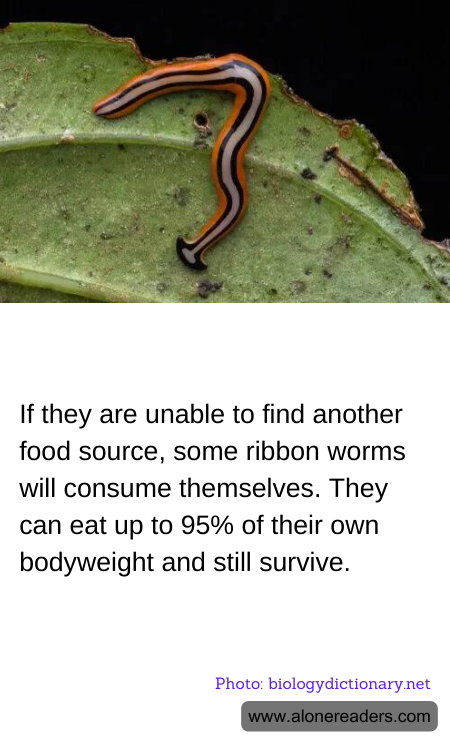
In the fascinating world of marine biology, ribbon worms, or nemerteans, stand out as a remarkable example of survival and adaptability. These intriguing creatures, which can be found in oceans, freshwater, and even on land, have developed a unique survival mechanism that allows them to endure periods of food scarcity. When faced with the threat of starvation, some ribbon worms resort to an extraordinary strategy: they consume themselves.
This self-cannibalistic behavior is not only a testament to the ribbon worm's resilience but also a fascinating insight into the lengths to which life can go to persist. Ribbon worms can consume up to 95% of their own body weight and still survive, a feat that seems almost miraculous. This process, known as autophagy, involves the worm breaking down its own tissues to use as a temporary food source. By doing so, the worm can sustain itself until it finds a more abundant food supply.
The ability to consume oneself and survive is a rare trait in the animal kingdom, highlighting the ribbon worm's unique evolutionary adaptations. This self-preservation technique is not without its risks, as consuming too much of their own body can lead to irreversible damage. However, the ribbon worm's ability to regenerate lost tissues allows it to recover once external food sources become available again. This regenerative capability is another remarkable aspect of their biology, enabling them to bounce back from extreme conditions that would be fatal to many other organisms.
The ribbon worm's self-cannibalism is a stark reminder of the harsh realities of life in the wild, where survival often hinges on adaptability and resourcefulness. It also underscores the incredible diversity of survival strategies employed by different species across the globe. While the idea of consuming oneself might seem extreme, it is a testament to the ribbon worm's tenacity and the complex interplay of biological processes that sustain life.
For scientists and nature enthusiasts alike, the ribbon worm's ability to eat itself and survive offers a captivating glimpse into the wonders of evolution and the resilience of life. It serves as a reminder of the myriad ways in which organisms have adapted to their environments, each with its own unique set of challenges and solutions. As we continue to explore and understand the natural world, the ribbon worm stands as a symbol of life's enduring capacity to adapt and thrive, even in the face of adversity.
