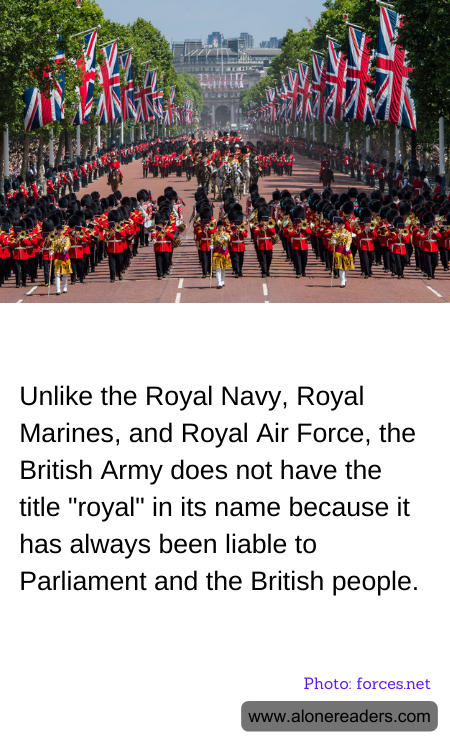
The British Army, unlike its counterparts in the Royal Navy, Royal Marines, and Royal Air Force, does not bear the title "royal" in its name. This distinction is not merely a matter of tradition or oversight but is deeply rooted in the historical relationship between the army, the monarchy, and the British Parliament. Understanding this unique aspect of the British Army's identity requires a look back at its origins and the evolution of military power in the United Kingdom.
The British Army's origins can be traced back to the tumultuous times of the English Civil War in the mid-17th century. During this period, the struggle for power between the monarchy and Parliament led to the establishment of a standing army that was directly accountable to Parliament. This was a significant shift from the earlier feudal system, where military forces were primarily loyal to the monarch. The New Model Army, formed in 1645, was a professional force that answered to Parliament, marking the beginning of a tradition of parliamentary control over the army.
This parliamentary oversight was further solidified with the Glorious Revolution of 1688, which resulted in the establishment of a constitutional monarchy. The Bill of Rights 1689 ensured that the army could not be maintained without the consent of Parliament, reinforcing the principle that the military should serve the state and its people, rather than the monarch alone. This principle has been a cornerstone of British democracy, ensuring that the army remains a national institution rather than a royal one.
In contrast, the Royal Navy, Royal Marines, and Royal Air Force have historically been more closely associated with the monarchy. The Royal Navy, for instance, has been a symbol of British naval power and imperial reach, often acting under royal prerogative. The Royal Air Force, established in 1918, was granted its "royal" designation by King George V, reflecting the importance of air power to national defense and the monarchy's role in its development. The Royal Marines, with their origins dating back to 1664, have similarly been linked to the crown, serving as an elite force with a strong maritime tradition.
The absence of the "royal" title in the British Army's name is thus a reflection of its unique constitutional role. It underscores the army's accountability to the British people and their elected representatives, rather than to the monarchy. This distinction is not just a matter of nomenclature but a testament to the enduring principles of parliamentary democracy and civilian control over the military.
In today's world, where the British Army continues to play a vital role in national and international security, its identity as a parliamentary force remains a defining feature. It serves as a reminder of the balance of power between the military, the government, and the people, ensuring that the army remains a force for the nation as a whole, rather than a tool of royal authority. This unique status is a proud part of the British Army's heritage, reflecting its commitment to serving the interests of the country and its citizens.
