More About This Card
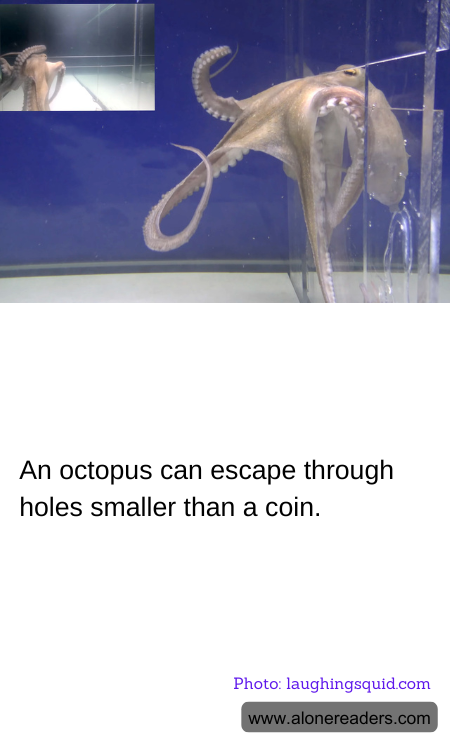
The octopus, a fascinating marine creature, has long captivated the curiosity of scientists and ocean enthusiasts alike. One of its most remarkable abilities is its capacity to escape through incredibly small openings, sometimes even smaller than a coin. This extraordinary skill is not only a testament to the octopus's adaptability but also a fascinating example of nature's ingenuity.
At the heart of this ability lies the unique physiology of the octopus. Unlike many animals, the octopus lacks a rigid skeleton. Its body is composed almost entirely of soft tissue, which allows it to compress and contort itself to fit through tight spaces. The only hard part of an octopus's body is its beak, which is similar in structure to a parrot's beak and located at the base of its arms. As long as the beak can fit through an opening, the rest of the octopus can follow.
This remarkable flexibility is not just a party trick; it serves as a crucial survival mechanism. In the wild, octopuses often find themselves in precarious situations, whether evading predators or seeking out prey. The ability to squeeze through small crevices allows them to hide from larger threats and access food sources that are out of reach for other predators. This skill is also beneficial in captivity, where octopuses have been known to escape from aquariums through seemingly impossible routes, much to the surprise of their human caretakers.
The octopus's escape artistry is further enhanced by its intelligence and problem-solving capabilities. Octopuses are known for their cognitive abilities, which include learning through observation and memory retention. These skills enable them to navigate complex environments and devise escape strategies that would be unthinkable for less intelligent creatures. Their ability to manipulate objects and understand spatial relationships is akin to that of some vertebrates, making them one of the most intelligent invertebrates on the planet.
In addition to their physical and cognitive prowess, octopuses possess a remarkable ability to change color and texture, thanks to specialized cells in their skin called chromatophores. This camouflage capability allows them to blend seamlessly into their surroundings, further aiding their escape from predators and enhancing their ability to surprise prey.
The octopus's ability to escape through small openings is a marvel of nature that continues to intrigue and inspire. It serves as a reminder of the incredible adaptability and resourcefulness of life in the ocean. As we continue to explore and learn about these enigmatic creatures, we gain not only a deeper appreciation for their unique abilities but also a greater understanding of the complex and wondrous world beneath the waves.