More About This Card
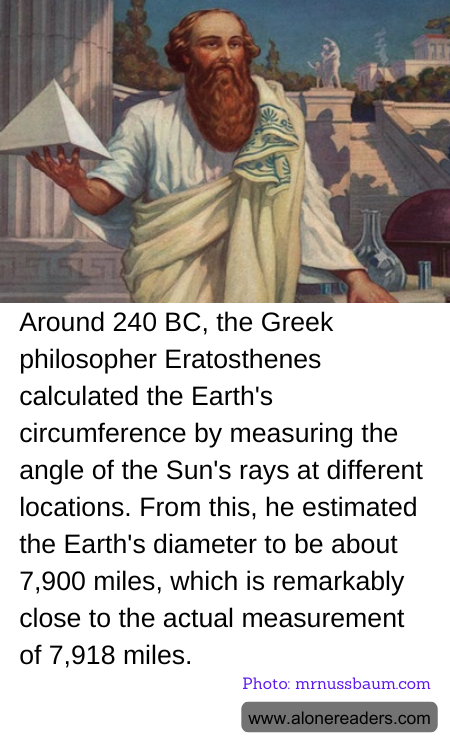
In the annals of scientific history, few achievements stand as a testament to human ingenuity and curiosity quite like the work of Eratosthenes, a Greek philosopher and mathematician who lived around 240 BC. At a time when the Earth was often thought to be flat or of indeterminate shape, Eratosthenes embarked on an intellectual journey that would lead to one of the earliest known calculations of the Earth's circumference. His method, both simple and profound, laid the groundwork for future explorations and discoveries.
Eratosthenes was the chief librarian at the Library of Alexandria, a hub of knowledge and learning in the ancient world. His curiosity was piqued by a simple observation: in the city of Syene (modern-day Aswan, Egypt), the Sun cast no shadow at noon during the summer solstice, as it was directly overhead. However, in Alexandria, located approximately 500 miles north of Syene, the Sun did cast a shadow at the same time. This difference in shadow length suggested that the Earth's surface was curved.
Using this observation, Eratosthenes devised a clever experiment. He measured the angle of the shadow in Alexandria and found it to be about 7.2 degrees, or roughly 1/50th of a full circle. He reasoned that if the Earth were a sphere, the distance between Syene and Alexandria would represent 1/50th of the Earth's total circumference. By multiplying the distance between the two cities by 50, he estimated the Earth's circumference to be approximately 24,662 miles. From this, he calculated the Earth's diameter to be about 7,900 miles, astonishingly close to the modern measurement of 7,918 miles.
Eratosthenes' calculation was not only a remarkable feat of mathematics and observation but also a demonstration of the power of human reasoning. His work showed that with careful observation and logical deduction, it was possible to understand the world in ways that transcended the limitations of the technology of his time. His method relied on basic geometry and a keen understanding of the natural world, principles that continue to underpin scientific inquiry today.
The legacy of Eratosthenes extends beyond his calculation of the Earth's size. His work inspired generations of scientists and explorers, encouraging them to question, measure, and understand the world around them. In an era where much of the Earth was still shrouded in mystery, Eratosthenes' achievement was a beacon of knowledge, illuminating the path for future discoveries.
Today, as we look back on the accomplishments of ancient scholars like Eratosthenes, we are reminded of the enduring power of curiosity and the human spirit's relentless pursuit of knowledge. His story is a testament to the idea that even the simplest observations can lead to profound insights, a lesson that continues to resonate with learners and thinkers of all ages.