More About This Card
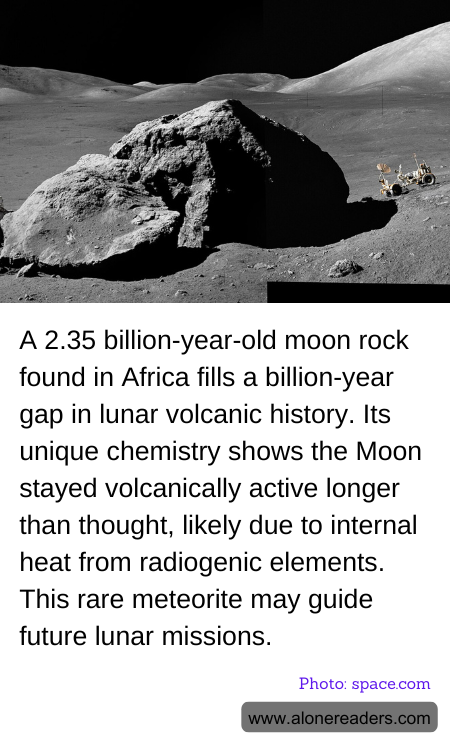
In a groundbreaking discovery that has captivated the scientific community, a 2.35 billion-year-old moon rock has been found in Africa, offering new insights into the Moon's volcanic history. This rare lunar meteorite, with its unique chemical composition, has filled a billion-year gap in our understanding of lunar volcanism, suggesting that the Moon remained volcanically active much longer than previously believed.
The Moon, Earth's closest celestial neighbor, has long been a subject of fascination and study. For decades, scientists have pieced together its history, primarily through samples collected during the Apollo missions. However, these samples provided a limited view, primarily covering the Moon's early volcanic activity. The discovery of this ancient moon rock in Africa has now extended the timeline of lunar volcanism, revealing that volcanic activity persisted well into the Moon's middle age.
The unique chemistry of this meteorite is key to understanding why the Moon remained active for such an extended period. Scientists have identified the presence of radiogenic elements within the rock, which are known to produce heat through radioactive decay. This internal heat likely sustained volcanic activity on the Moon, challenging previous assumptions that the Moon's volcanic life had ended much earlier. The presence of these elements suggests that the Moon's interior was more dynamic and complex than previously thought, with heat-producing processes that could have fueled volcanic eruptions over a prolonged period.
This discovery not only reshapes our understanding of the Moon's geological history but also has significant implications for future lunar exploration. As space agencies and private companies plan missions to the Moon, this meteorite could serve as a guide, helping to identify regions of interest for further study. Understanding the Moon's volcanic past is crucial for unraveling its geological evolution and assessing its potential for future human habitation.
Moreover, the study of this moon rock could provide valuable insights into the broader processes of planetary formation and evolution. By comparing the Moon's volcanic history with that of Earth and other celestial bodies, scientists can gain a deeper understanding of the forces that shape planets and moons across the solar system.
In conclusion, the discovery of this ancient moon rock in Africa is a testament to the enduring mysteries of our solar system. It highlights the importance of continued exploration and study, as each new finding has the potential to rewrite our understanding of the universe. As we look to the future, this rare meteorite serves as a reminder of the Moon's dynamic past and the endless possibilities that await us in the exploration of space.