More About This Card
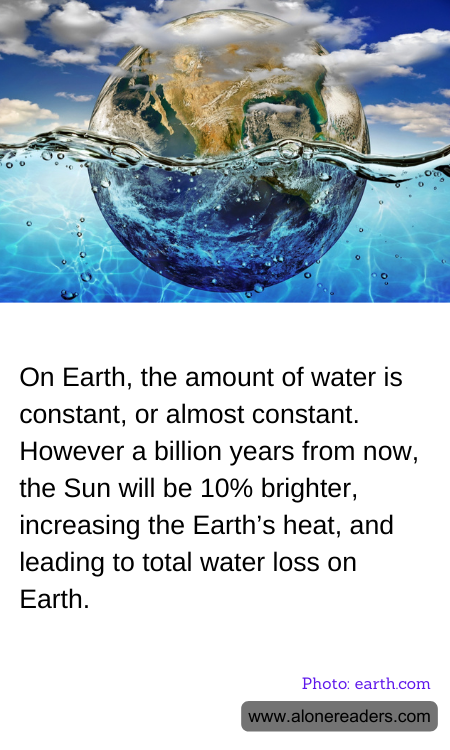
The Earth, our blue planet, is unique in the solar system for its abundant water resources. This precious liquid covers about 71% of the Earth's surface and is vital for all known forms of life. Remarkably, the total amount of water on Earth has remained relatively constant over millions of years. This is due to the planet's efficient water cycle, which continuously recycles water through evaporation, condensation, and precipitation. However, this balance is not eternal. A billion years from now, the Earth may face a dramatic transformation due to changes in the Sun's brightness.
The Sun, a dynamic star, is gradually becoming brighter as it ages. In approximately one billion years, it is expected to be about 10% brighter than it is today. This increase in solar luminosity will have profound effects on the Earth's climate and environment. As the Sun's energy output grows, the Earth's surface temperature will rise, leading to significant changes in the planet's atmosphere and hydrosphere.
One of the most concerning consequences of this increased solar output is the potential for total water loss on Earth. As the planet warms, the oceans will begin to evaporate at an accelerated rate. This process will increase the amount of water vapor in the atmosphere, which is a potent greenhouse gas. The enhanced greenhouse effect will further elevate global temperatures, creating a feedback loop that accelerates the evaporation of water.
Eventually, the Earth's oceans could reach a critical point where they can no longer exist in liquid form. The water vapor in the atmosphere will be broken down by solar radiation into hydrogen and oxygen. The lightweight hydrogen will escape into space, while the oxygen may react with other elements or be lost as well. This process, known as hydrodynamic escape, could lead to the complete desiccation of the planet, leaving it barren and lifeless.
While this scenario is daunting, it is important to remember that it is a natural part of the Sun's life cycle and the evolution of planetary systems. The timeline for these changes is vast, spanning a billion years, which is far beyond the current human timescale. Nevertheless, understanding these long-term processes can provide valuable insights into the future of our planet and the importance of preserving its current state.
In the meantime, humanity's focus should remain on addressing more immediate environmental challenges, such as climate change and resource conservation. By taking care of our planet today, we can ensure that it remains a hospitable home for generations to come, even as we ponder the distant future of a world without water.