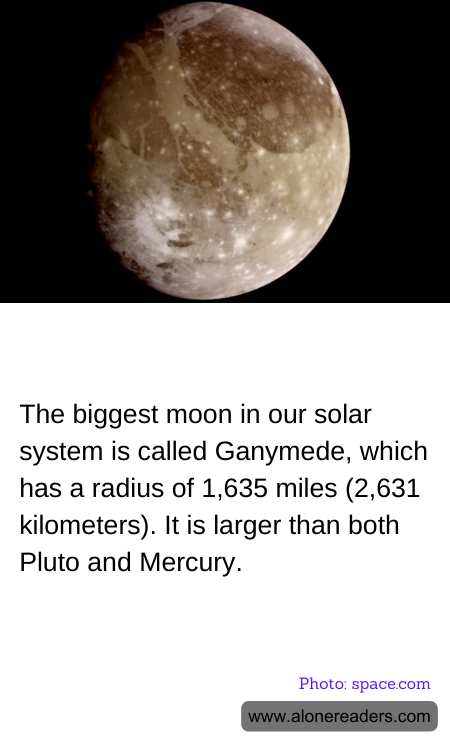
In the vast expanse of our solar system, where celestial bodies dance in a cosmic ballet, Ganymede stands out as a giant among moons. Orbiting Jupiter, Ganymede is not only the largest moon in our solar system but also a fascinating world that surpasses even some planets in size. With a radius of 1,635 miles (2,631 kilometers), Ganymede is larger than both Pluto and Mercury, making it a subject of great interest for astronomers and space enthusiasts alike.
Ganymede's sheer size is just one of its remarkable features. This colossal moon is unique in many ways, including its composition and geological characteristics. Unlike most moons, Ganymede has a differentiated interior, meaning it has a core, mantle, and crust, much like Earth. Its surface is a mix of two types of terrain: highly cratered dark regions and lighter areas marked with grooves and ridges. These features suggest a history of tectonic activity, hinting at a dynamic past that continues to intrigue scientists.
One of the most captivating aspects of Ganymede is its magnetic field. It is the only moon known to have a significant magnetic field, which is believed to be generated by a liquid iron or iron-sulfide core. This magnetic field interacts with Jupiter's powerful magnetosphere, creating auroras at Ganymede's poles. These auroras are not just beautiful; they provide valuable clues about the moon's subsurface ocean, which is thought to lie beneath a thick layer of ice. This ocean could potentially harbor conditions suitable for life, making Ganymede a prime candidate in the search for extraterrestrial life within our solar system.
The exploration of Ganymede has been a priority for space missions. NASA's Galileo spacecraft, which orbited Jupiter from 1995 to 2003, provided a wealth of information about Ganymede's surface and magnetic field. Looking to the future, the European Space Agency's JUpiter ICy moons Explorer (JUICE) mission, set to launch in the 2020s, aims to study Ganymede in greater detail. This mission will focus on understanding the moon's ice shell, ocean, and potential habitability, further unraveling the mysteries of this giant moon.
Ganymede's allure extends beyond its scientific significance. It serves as a reminder of the wonders that await discovery in our solar system. As we continue to explore and learn more about Ganymede, we gain insights not only into the moon itself but also into the broader processes that shape planetary bodies. Whether through the lens of a telescope or the data from a spacecraft, Ganymede invites us to ponder the possibilities of life beyond Earth and the intricate workings of our cosmic neighborhood.
