More About This Card
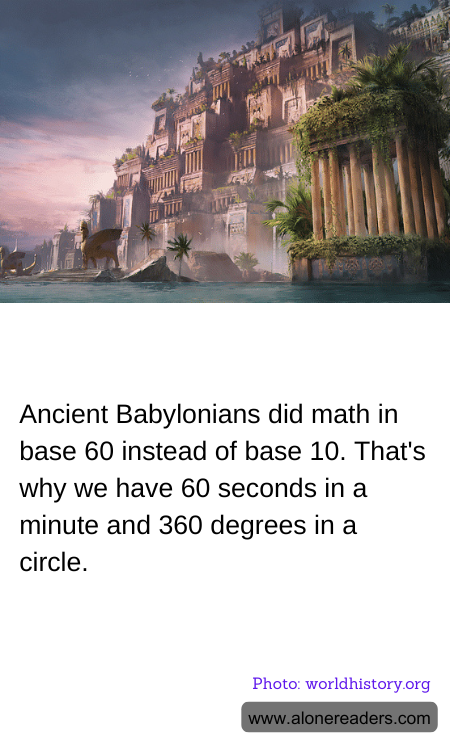
The ancient Babylonians, one of the most influential civilizations in history, had a unique approach to mathematics that continues to impact our daily lives. Unlike the base 10 system that most of the world uses today, the Babylonians used a base 60, or sexagesimal, system. This mathematical framework has left a lasting legacy, most notably in the way we measure time and angles.
The choice of base 60 might seem unusual at first glance, but it was a practical decision for the Babylonians. The number 60 is highly composite, meaning it has many divisors. Specifically, it can be evenly divided by 1, 2, 3, 4, 5, 6, 10, 12, 15, 20, and 30. This made calculations involving fractions much simpler and more versatile, which was particularly useful for trade, astronomy, and engineering—fields in which the Babylonians excelled.
One of the most enduring legacies of the Babylonian base 60 system is its influence on how we measure time. The division of an hour into 60 minutes and a minute into 60 seconds is a direct inheritance from this ancient civilization. This system of timekeeping has been adopted universally, transcending cultures and centuries, and remains a cornerstone of modern life. The precision and consistency it offers are crucial for everything from daily schedules to global communications.
Similarly, the division of a circle into 360 degrees is another testament to the Babylonian mathematical prowess. The choice of 360 is believed to be related to the approximate number of days in a year, making it a natural fit for astronomical observations and calculations. The use of 360 degrees in a circle allows for easy division into equal parts, facilitating the study of geometry and trigonometry. This division is so ingrained in our understanding of geometry that it is hard to imagine it any other way.
The Babylonian influence extends beyond just practical applications. Their mathematical innovations laid the groundwork for future civilizations, including the Greeks and Romans, who further developed these concepts. The sexagesimal system also played a crucial role in the development of algebra and calculus, fields that have shaped modern science and technology.
In essence, the ancient Babylonians' choice of a base 60 system was not just a mathematical curiosity but a foundational element that has shaped the way we understand and interact with the world. From the ticking of a clock to the angles of a triangle, the echoes of Babylonian mathematics are all around us. Their legacy is a testament to the enduring power of human ingenuity and the profound impact that ancient knowledge can have on future generations.