More About This Card
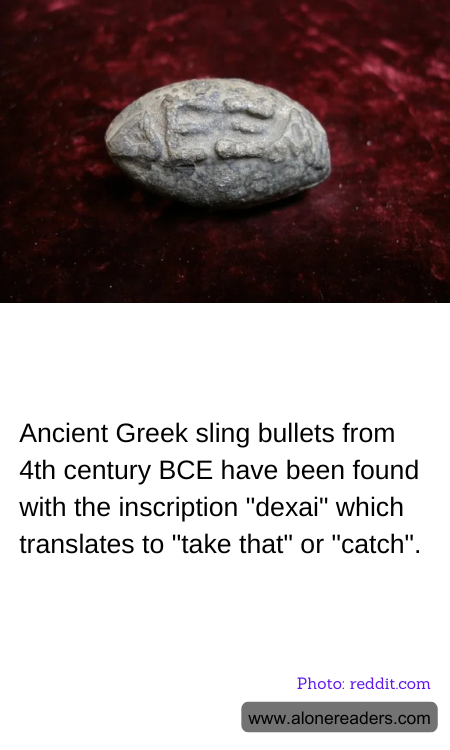
In the realm of ancient warfare, the sling was a deceptively simple yet highly effective weapon. Used by various civilizations, it was a tool that required skill and precision. Recent archaeological discoveries have shed light on the intriguing use of sling bullets by the Ancient Greeks, particularly those from the 4th century BCE. Among these findings are sling bullets inscribed with the word "dexai," which translates to "take that" or "catch." This discovery offers a fascinating glimpse into the psychological tactics employed by ancient warriors.
The sling bullet, typically made of lead or stone, was a small, oval-shaped projectile designed to be hurled at high speeds. While its primary function was to inflict physical damage, the inscriptions on these bullets suggest that they also served a psychological purpose. The word "dexai" inscribed on these bullets was likely intended to taunt or intimidate the enemy. Imagine being on the receiving end of such a projectile, not only facing the physical threat but also the psychological impact of a message that challenges you to "catch" the deadly missile.
This practice of inscribing messages on weapons is not unique to the Greeks, but it is a testament to their understanding of the psychological aspects of warfare. By inscribing a taunt on a sling bullet, Greek warriors could demoralize their opponents, instilling fear and hesitation. This tactic would have been particularly effective in the chaos of battle, where the mental state of soldiers could be as crucial as their physical prowess.
The discovery of these inscribed sling bullets also provides insight into the culture and mindset of the Ancient Greeks. It reflects their appreciation for wit and wordplay, even in the context of war. The use of humor and taunting in battle demonstrates a level of psychological sophistication that is often overlooked in discussions of ancient warfare. It highlights the Greeks' understanding that war was not just a physical contest but also a battle of wills.
Furthermore, these findings contribute to our broader understanding of ancient military history. They remind us that warfare has always been a complex interplay of technology, strategy, and psychology. The Greeks, known for their advancements in philosophy, art, and science, also applied their intellectual prowess to the battlefield, using every tool at their disposal to gain an advantage over their adversaries.
In conclusion, the inscribed sling bullets from the 4th century BCE offer a unique perspective on the psychological tactics of ancient Greek warfare. The simple yet powerful message of "dexai" serves as a reminder of the timeless nature of human conflict, where the mind can be as potent a weapon as any physical tool. These artifacts not only enrich our understanding of ancient military practices but also underscore the enduring complexity of human ingenuity in the face of adversity.