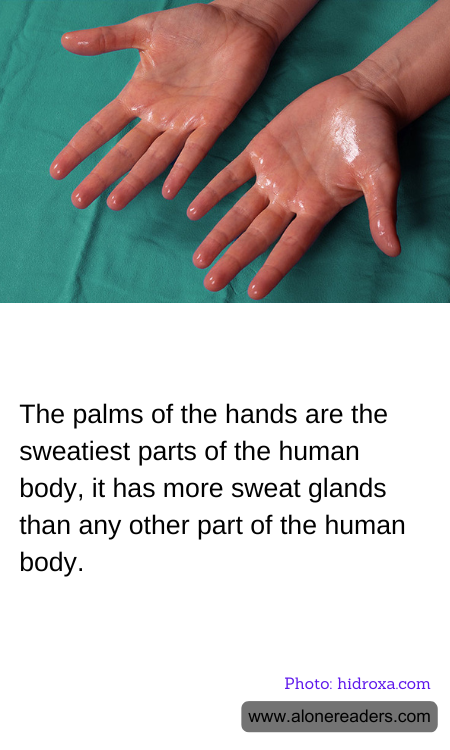
Sweaty palms are a common experience for many people, often occurring during moments of stress, excitement, or physical exertion. This phenomenon is due to the fact that the palms of the hands are the sweatiest parts of the human body, equipped with more sweat glands than any other area. Understanding why this happens and its implications can provide insight into human physiology and the body's natural responses.
The human body is covered with millions of sweat glands, which are crucial for regulating temperature and maintaining homeostasis. There are two main types of sweat glands: eccrine and apocrine. Eccrine glands are the most numerous and are found all over the body, but they are particularly concentrated in the palms, soles of the feet, and forehead. These glands are responsible for producing sweat that is primarily composed of water and salts, and they play a key role in cooling the body through evaporation.
The high concentration of eccrine glands in the palms is an evolutionary trait that has served humans well. In situations where grip and dexterity are essential, such as climbing or handling tools, a slight amount of moisture can enhance friction and improve grip. This is why our palms tend to sweat more in situations that require a firm hold or when we are under pressure, as the body instinctively prepares to optimize performance.
While sweaty palms can be beneficial in certain contexts, they can also be a source of discomfort or embarrassment, particularly in social or professional settings. For some individuals, excessive sweating of the palms, known as palmar hyperhidrosis, can be a persistent issue that affects daily life. This condition can be managed through various treatments, ranging from topical antiperspirants to more advanced medical interventions like iontophoresis or botulinum toxin injections.
Despite the occasional inconvenience, the presence of sweat glands in the palms is a testament to the body's intricate design and its ability to adapt to different situations. The natural response of sweating is a reminder of the body's complex mechanisms that work tirelessly to maintain balance and ensure survival. By understanding the reasons behind sweaty palms, individuals can better appreciate the body's natural processes and find ways to manage any discomfort they may experience.
In conclusion, the palms of the hands are uniquely equipped with a high density of sweat glands, making them the sweatiest parts of the human body. This characteristic, while sometimes bothersome, is an essential aspect of human physiology that has evolved to enhance grip and performance. Whether dealing with occasional sweaty palms or managing a more persistent condition, recognizing the role of these sweat glands can help individuals navigate their daily lives with greater ease and understanding.
