More About This Card
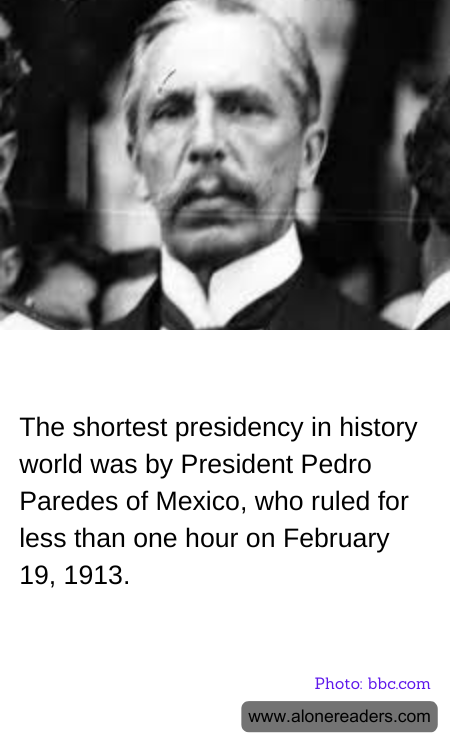
In the annals of world history, the presidency of Pedro Paredes of Mexico stands out as a remarkable footnote due to its brevity. On February 19, 1913, Paredes assumed the presidency for less than one hour, marking the shortest presidency ever recorded. This fleeting moment of leadership occurred during a turbulent period in Mexican history, characterized by political upheaval and rapid changes in government.
The backdrop to Paredes's brief presidency was the Mexican Revolution, a complex and multifaceted conflict that began in 1910 and continued for over a decade. The revolution was driven by widespread dissatisfaction with the long-standing dictatorship of Porfirio Díaz and the desire for social and economic reforms. As the revolution unfolded, it led to a series of power struggles and coups, with various factions vying for control of the country.
Pedro Paredes's ascent to the presidency was a direct result of the chaotic events of the Ten Tragic Days, a violent coup that took place in Mexico City from February 9 to February 19, 1913. During this period, President Francisco I. Madero and his vice president, José María Pino Suárez, were overthrown by a military coup led by General Victoriano Huerta. As the coup unfolded, Paredes, who was a minor political figure, was briefly appointed as interim president in the midst of the turmoil.
Paredes's presidency was largely symbolic, serving as a placeholder during the transition of power. His appointment was part of a broader strategy by the coup leaders to legitimize their actions and stabilize the situation. However, his time in office was so short that it left no significant impact on the country's political landscape. Within an hour, General Huerta assumed the presidency, marking the end of Paredes's ephemeral leadership.
Despite its brevity, Paredes's presidency is a testament to the intense political instability that characterized Mexico during the early 20th century. It highlights the rapid shifts in power and the often unpredictable nature of revolutionary movements. While Paredes himself remains a relatively obscure figure in history, his brief tenure as president serves as a reminder of the tumultuous times in which he lived.
Today, the story of Pedro Paredes's one-hour presidency is a fascinating historical anecdote that captures the imagination. It underscores the complexities of political transitions and the often fleeting nature of power. For those interested in the history of Mexico and the broader dynamics of revolutionary change, Paredes's presidency offers a unique glimpse into a moment of profound uncertainty and transformation.