More About This Card
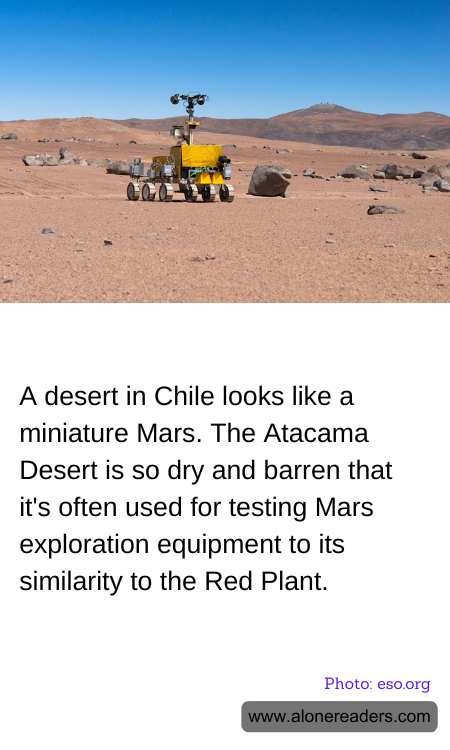
Nestled along the Pacific coast of South America, the Atacama Desert in Chile is a place of stark beauty and extreme conditions. Often described as the driest non-polar desert in the world, it stretches over 600 miles from the southern border of Peru to the northern reaches of Chile. Its barren landscape, characterized by vast salt flats, rugged mountains, and rocky terrain, bears an uncanny resemblance to the surface of Mars, earning it the nickname "Earth's Mars."
The Atacama Desert's resemblance to the Red Planet is not just superficial. Its hyper-arid conditions, with some weather stations recording no significant rainfall for hundreds of years, create an environment where life struggles to gain a foothold. This makes it an ideal location for scientists and researchers to test equipment and conduct experiments intended for Mars exploration. The desert's soil, rich in minerals and devoid of organic material, closely mimics the Martian regolith, providing a perfect testing ground for rovers and other exploratory technologies.
NASA and other space agencies have long recognized the Atacama's potential as a stand-in for Mars. Over the years, various missions have utilized this unique environment to trial new technologies and refine techniques for future Mars missions. For instance, the Mars Science Laboratory, which includes the Curiosity rover, underwent rigorous testing in the Atacama before its successful deployment on Mars. The desert's challenging conditions help engineers and scientists anticipate and solve potential problems that could arise on the Martian surface.
Beyond its scientific applications, the Atacama Desert captivates visitors with its otherworldly landscapes. The Valle de la Luna, or Valley of the Moon, is a popular destination where wind-sculpted dunes and jagged rock formations create a surreal vista reminiscent of lunar landscapes. At night, the desert transforms into one of the best stargazing locations on Earth, thanks to its high altitude, clear skies, and lack of light pollution. This celestial spectacle adds another layer of allure to the desert, drawing astronomers and tourists alike.
The Atacama Desert's role as a proxy for Mars exploration underscores the interconnectedness of our planet with the broader universe. It serves as a reminder of the challenges and wonders that lie beyond our world, inspiring curiosity and innovation. As humanity continues to look to the stars, the Atacama remains a vital link in our quest to understand and explore the cosmos, offering a glimpse of what it might be like to set foot on another planet.