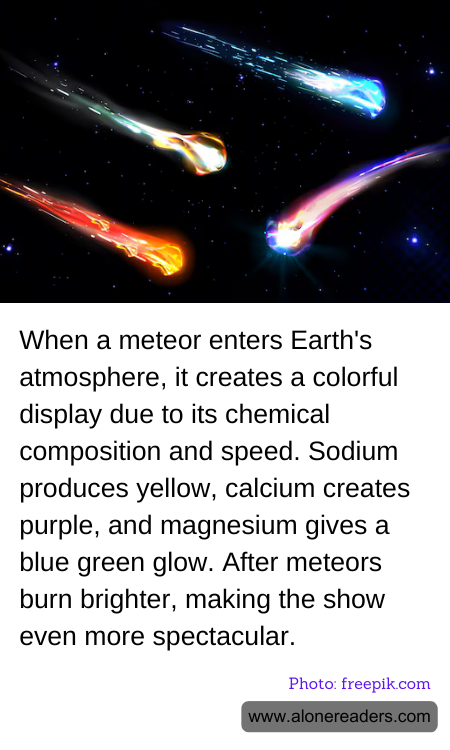
When a meteor enters Earth's atmosphere, it transforms the night sky into a canvas of vibrant colors, captivating observers with its dazzling display. This celestial phenomenon, often referred to as a "shooting star," is not just a simple streak of light. It is a complex interaction between the meteor's speed, its chemical composition, and the Earth's atmospheric conditions.
As meteors hurtle through space, they travel at incredible speeds, often exceeding 20 kilometers per second. Upon entering the Earth's atmosphere, they encounter air resistance, which causes them to heat up rapidly. This intense heat causes the meteor to glow and, in some cases, disintegrate. The colors we see are a result of the different elements within the meteor vaporizing and emitting light at specific wavelengths.
Sodium, a common element found in meteors, is responsible for producing a bright yellow glow. This is often one of the most noticeable colors in a meteor's trail. Calcium, another element, contributes to the meteor's colorful display by creating a purple hue. Meanwhile, magnesium, known for its brilliant white light, adds a blue-green tint to the spectacle. Each element's unique emission spectrum combines to create a mesmerizing array of colors that dance across the sky.
The brilliance of a meteor's display is further enhanced by its brightness. As the meteor burns brighter, it becomes more visible against the dark backdrop of the night sky, making the show even more spectacular. Larger meteors, or fireballs, can produce exceptionally bright displays, sometimes even visible during daylight hours. These fireballs can leave behind glowing trails that linger for several seconds, adding to the awe-inspiring experience.
For many, witnessing a meteor shower is a magical experience, a reminder of the vastness and beauty of the universe. These events occur when the Earth passes through the debris left by comets or asteroids, resulting in multiple meteors streaking across the sky. The Perseids and the Geminids are among the most well-known meteor showers, drawing enthusiasts and casual observers alike to gaze upwards in anticipation.
In conclusion, the colorful display of a meteor entering Earth's atmosphere is a testament to the wonders of nature and the intricate dance of elements and forces at play. Whether it's the yellow glow of sodium, the purple of calcium, or the blue-green of magnesium, each meteor offers a unique and fleeting glimpse into the cosmos. For those fortunate enough to witness this celestial event, it is a moment of wonder and reflection, a reminder of the beauty that exists beyond our world.
