More About This Card
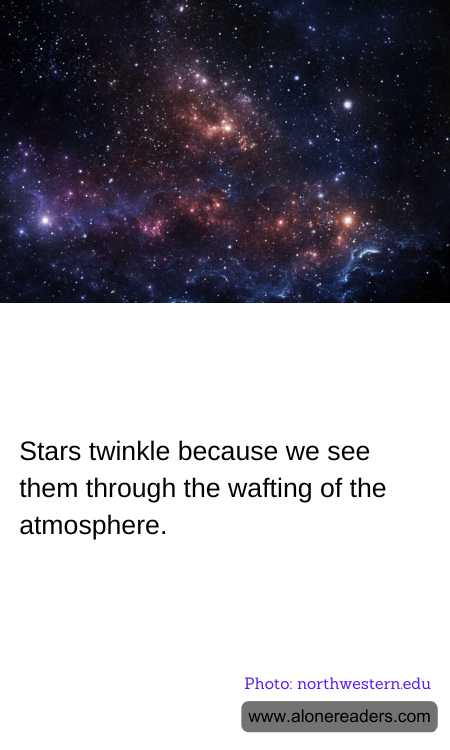
When we gaze up at the night sky, the twinkling of stars often captivates us, adding a magical quality to the celestial display. This twinkling, scientifically known as stellar scintillation, is not due to any intrinsic property of the stars themselves but rather a result of the Earth's atmosphere. Understanding why stars twinkle involves delving into the interaction between starlight and the layers of gases that envelop our planet.
As starlight travels through the vastness of space, it remains relatively undisturbed until it reaches the Earth's atmosphere. Here, the light encounters a dynamic environment composed of various layers of air, each with differing temperatures and densities. These atmospheric layers are constantly in motion, influenced by factors such as wind, temperature gradients, and pressure changes. This movement causes the air to act like a series of lenses, bending and refracting the light in unpredictable ways.
The bending of light, or refraction, occurs because light travels at different speeds through different mediums. When starlight enters the Earth's atmosphere, it slows down and changes direction slightly. As the light passes through the turbulent layers of air, it is refracted multiple times, causing the light's path to shift. This shifting path is what we perceive as the twinkling of stars. The effect is more pronounced when stars are closer to the horizon, as their light passes through a greater thickness of the atmosphere, encountering more turbulence and thus more refraction.
Interestingly, planets do not twinkle as much as stars. This is because planets, being much closer to Earth, appear as tiny disks rather than point sources of light. The light from these disks averages out the effects of atmospheric turbulence, resulting in a steadier appearance. In contrast, stars are so far away that they appear as single points of light, making them more susceptible to the atmospheric disturbances that cause twinkling.
The twinkling of stars is not just a charming phenomenon for stargazers; it also presents challenges for astronomers. The distortion caused by the atmosphere can blur the images of celestial objects, complicating observations. To counteract this, astronomers use adaptive optics technology, which adjusts the telescope's optics in real-time to compensate for atmospheric turbulence, allowing for clearer and more detailed images of the stars.
In conclusion, the twinkling of stars is a beautiful reminder of the dynamic nature of our planet's atmosphere. While it adds a poetic touch to our night sky, it also highlights the complex interplay between light and the ever-changing air above us. Whether you're a casual observer or a seasoned astronomer, the twinkling stars serve as a testament to the wonders of the universe and the intricate processes that govern our view of it.