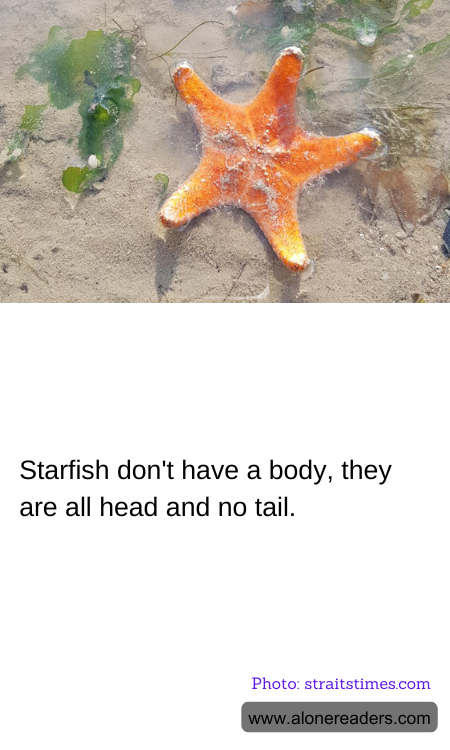
Starfish, also known as sea stars, are fascinating marine creatures that defy conventional anatomical structures. Unlike most animals, starfish do not have a distinct body with a head and tail. Instead, they possess a unique radial symmetry that makes them appear as if they are all head and no tail. This intriguing feature is a testament to the diversity and adaptability of life in the ocean.
The anatomy of a starfish is quite different from the bilateral symmetry seen in humans and many other animals. Starfish typically have a central disc from which five or more arms radiate. This radial symmetry allows them to move in any direction without the need for a head or tail to guide them. The absence of a centralized brain does not hinder their ability to navigate their environment; instead, they have a complex network of nerves that coordinate their movements and responses to stimuli.
One of the most remarkable aspects of starfish is their ability to regenerate lost limbs. This regenerative capability is not only a survival mechanism but also a reflection of their decentralized body structure. If a starfish loses an arm, it can grow a new one, and in some cases, an entire new starfish can regenerate from a single severed limb. This adaptability is crucial for their survival in the often harsh and competitive marine ecosystems.
Starfish are equipped with tube feet located on the underside of their arms, which they use for locomotion and feeding. These tube feet operate through a hydraulic system, allowing the starfish to adhere to surfaces and manipulate their environment. This system is controlled by a water vascular system, which is unique to echinoderms, the phylum to which starfish belong. The absence of a head and tail does not impede their ability to hunt; instead, they use their tube feet to pry open the shells of mollusks, their primary prey.
The sensory capabilities of starfish are also distributed throughout their bodies. They possess eye spots at the tips of their arms, which can detect changes in light and dark, helping them navigate their surroundings. This decentralized sensory system allows them to respond to threats and opportunities from any direction, further emphasizing their all-head, no-tail anatomy.
In conclusion, starfish are a remarkable example of nature's ingenuity. Their unique body structure, characterized by radial symmetry and the absence of a distinct head and tail, allows them to thrive in diverse marine environments. Their ability to regenerate, coupled with their decentralized nervous and sensory systems, makes them a fascinating subject of study for scientists and a source of wonder for people of all ages. Whether observed in a tide pool or an aquarium, starfish continue to captivate with their extraordinary adaptations and resilience.
