More About This Card
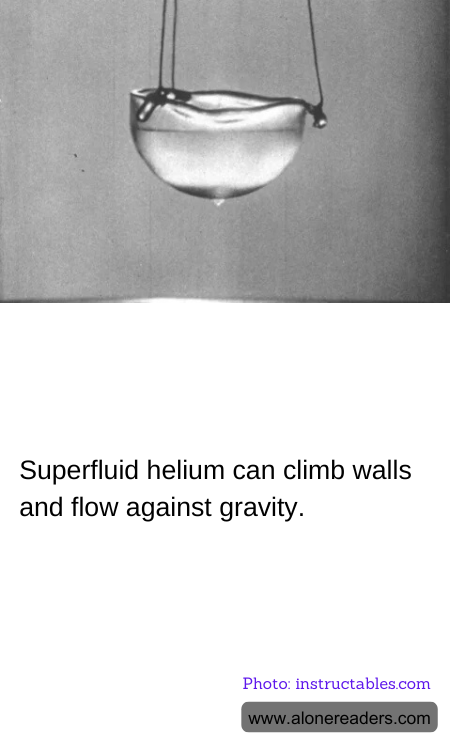
In the fascinating world of quantum physics, superfluid helium stands out as a substance that defies our everyday understanding of liquids and gravity. When helium is cooled to temperatures near absolute zero, it enters a superfluid state, exhibiting extraordinary properties that challenge conventional physics. One of the most intriguing behaviors of superfluid helium is its ability to climb walls and flow against gravity, a phenomenon that has captivated scientists and laypeople alike.
At temperatures below 2.17 Kelvin, helium transitions into a superfluid state, characterized by the complete absence of viscosity. This means that superfluid helium can flow without any resistance, allowing it to move in ways that seem impossible to those familiar with ordinary liquids. One of the most striking demonstrations of this property is the "Rollin film" effect, where a thin layer of superfluid helium climbs up the walls of a container and overflows, seemingly defying gravity. This occurs because the superfluid seeks to minimize its energy by spreading out as much as possible, even if it means moving against gravitational forces.
The ability of superfluid helium to climb walls is not just a curious trick; it provides profound insights into the quantum mechanical nature of matter. In the superfluid state, helium atoms move in a coordinated manner, behaving more like a single quantum entity than a collection of individual particles. This collective behavior is a result of Bose-Einstein condensation, a state of matter where particles occupy the same quantum state, allowing them to move in unison. This unique property enables superfluid helium to exhibit frictionless flow and climb surfaces effortlessly.
The study of superfluid helium has far-reaching implications beyond its peculiar ability to defy gravity. It serves as a macroscopic manifestation of quantum mechanics, offering a tangible glimpse into the world of quantum phenomena. Researchers are exploring potential applications of superfluidity in various fields, including quantum computing and precision measurement technologies. The frictionless flow of superfluids could lead to advancements in creating highly sensitive gyroscopes and accelerometers, which are crucial for navigation systems and scientific instruments.
Superfluid helium's ability to climb walls and flow against gravity is a testament to the wonders of quantum physics. It challenges our perceptions of how liquids should behave and opens up new avenues for scientific exploration and technological innovation. As researchers continue to unravel the mysteries of superfluidity, we can expect to gain deeper insights into the fundamental principles governing the universe, potentially leading to breakthroughs that could transform our understanding of the physical world.