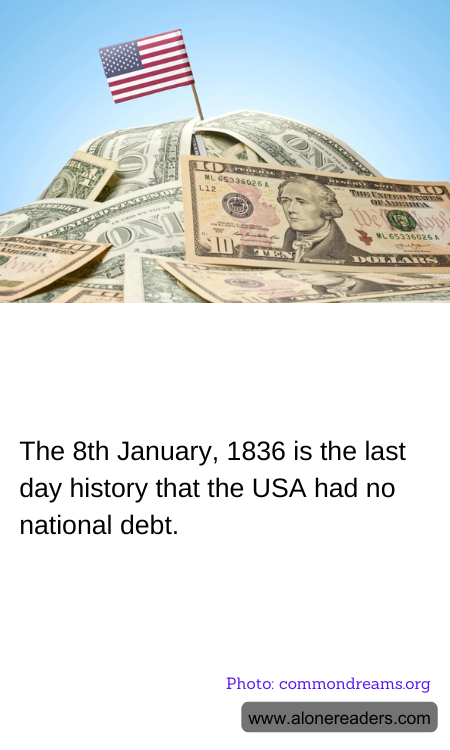
On January 8, 1836, the United States achieved a remarkable financial milestone that has since become a historical anomaly: it was the last day the nation was free from national debt. This brief moment of fiscal freedom was the result of a series of economic policies and circumstances that converged to allow the U.S. government to pay off its debts completely, a feat that has not been replicated since.
The journey to a debt-free status began with the presidency of Andrew Jackson, who was a staunch advocate for reducing the national debt. Jackson viewed debt as a "national curse" and was determined to eliminate it. His administration implemented a series of measures aimed at fiscal responsibility, including reducing government spending and vetoing bills that he believed would lead to unnecessary expenditures. Jackson's fiscal policies were complemented by a period of economic prosperity and expansion, which increased government revenues through tariffs and land sales.
The sale of public lands played a significant role in the elimination of the national debt. During this period, the U.S. was experiencing rapid westward expansion, and the government capitalized on this by selling vast tracts of land to settlers and speculators. The revenue generated from these sales was substantial, contributing significantly to the government's ability to pay off its debts. Additionally, the Tariff of 1828, known as the "Tariff of Abominations," imposed high duties on imported goods, further boosting government income.
However, the debt-free status was short-lived. By the end of 1836, the U.S. was once again in debt due to a combination of factors, including the Panic of 1837, a financial crisis that led to a severe economic downturn. The crisis was partly triggered by Jackson's Specie Circular, an executive order that required payment for government land to be in gold and silver, leading to a shortage of hard currency and a collapse in land prices. The ensuing economic turmoil necessitated government borrowing, marking the end of the debt-free era.
Today, the notion of a debt-free United States seems almost unimaginable, with the national debt exceeding trillions of dollars. The brief period in 1836 serves as a historical footnote, a reminder of a time when the nation managed to balance its books completely. It highlights the complexities and challenges of managing a nation's finances and the impact of economic policies and external factors on national debt.
While the circumstances of the 1830s are vastly different from today's global economic landscape, the story of the United States' debt-free day continues to captivate historians and economists alike. It serves as a testament to the possibilities of fiscal discipline and the unpredictable nature of economic forces, offering valuable lessons for future generations.
