More About This Card
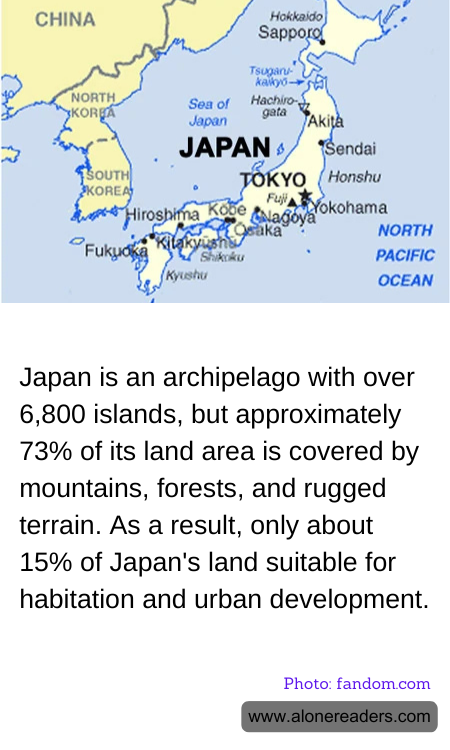
Japan, a fascinating archipelago in East Asia, is renowned for its unique blend of ancient traditions and cutting-edge technology. Comprising over 6,800 islands, Japan's geographical diversity is as intriguing as its cultural heritage. Despite its vast number of islands, the country's land area presents a significant challenge for habitation and urban development due to its predominantly mountainous and forested terrain.
Approximately 73% of Japan's land is covered by mountains, forests, and rugged landscapes. This topographical characteristic has profoundly influenced the nation's development patterns and population distribution. The Japanese Alps, Mount Fuji, and other mountain ranges dominate the landscape, offering breathtaking vistas and a haven for biodiversity. These natural features, while beautiful, limit the amount of land available for agriculture, urbanization, and infrastructure development.
As a result, only about 15% of Japan's land is suitable for habitation and urban development. This limited space has led to the concentration of the population in urban areas, particularly in coastal regions and plains. Major cities like Tokyo, Osaka, and Yokohama have become bustling metropolises, characterized by their dense populations and innovative urban planning. The scarcity of habitable land has driven Japan to develop some of the world's most efficient and technologically advanced urban environments.
The challenge of limited space has also fostered a culture of innovation and adaptability. Japan has become a global leader in maximizing the use of available land through vertical construction, efficient public transportation systems, and sustainable urban planning. The country's architects and city planners have pioneered techniques to create livable spaces that blend seamlessly with the natural environment, ensuring that urban development does not come at the expense of Japan's rich natural heritage.
Moreover, the mountainous and forested areas that dominate Japan's landscape are not merely obstacles to development but are also treasured for their ecological and cultural significance. These regions are home to a diverse array of flora and fauna and are integral to Japan's cultural identity. They offer opportunities for tourism, recreation, and spiritual reflection, drawing visitors from around the world to experience their serene beauty.
In conclusion, Japan's geographical constraints have shaped its society in profound ways, driving innovation and fostering a deep respect for the natural world. The country's ability to balance urban development with the preservation of its natural landscapes serves as a model for sustainable living. As Japan continues to navigate the challenges of limited habitable land, it remains a testament to human ingenuity and the enduring bond between people and nature.