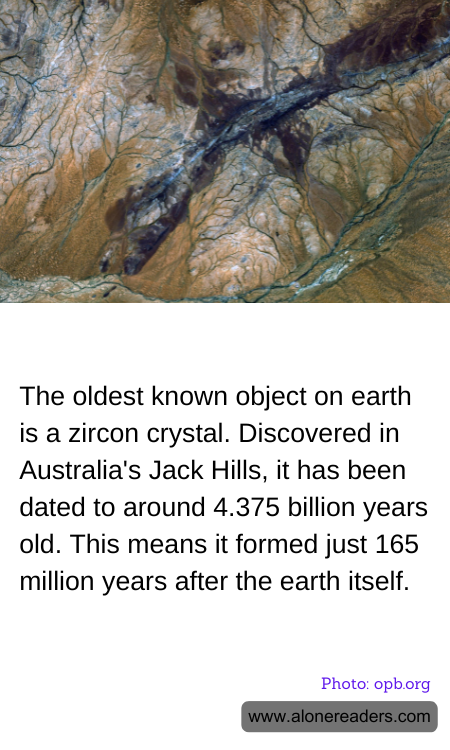
In the vast timeline of Earth's history, few discoveries capture the imagination quite like the ancient zircon crystals found in the Jack Hills of Western Australia. These tiny, unassuming minerals hold within them a story that stretches back nearly to the dawn of our planet. Dated to approximately 4.375 billion years old, these zircons are the oldest known objects on Earth, offering a rare glimpse into the planet's formative years.
Zircon crystals are remarkable not just for their age but for their resilience. Formed from the mineral zirconium silicate, these crystals can withstand intense geological processes, preserving their structure and composition over billions of years. This durability makes them invaluable to scientists seeking to understand the early conditions of Earth. The zircon crystals from Jack Hills are particularly significant because they formed just 165 million years after the Earth itself, a period when the planet was still in its infancy.
The discovery of these ancient zircons has provided critical insights into the early Earth. By analyzing the isotopic composition of the crystals, scientists have been able to infer details about the planet's early crust and the presence of water. The existence of these zircons suggests that Earth's crust had already begun to solidify and that liquid water might have been present much earlier than previously thought. This challenges earlier models of Earth's development and has implications for understanding the conditions that led to the emergence of life.
The journey of these zircons from formation to discovery is a testament to the dynamic nature of our planet. Over billions of years, they have been subjected to tectonic shifts, volcanic eruptions, and erosion, yet they have endured. Their survival is a reminder of the Earth's ever-changing landscape and the forces that have shaped it over eons.
For scientists and enthusiasts alike, the Jack Hills zircons are more than just ancient rocks; they are a window into a time when Earth was a vastly different place. They remind us of the planet's long and complex history and the ongoing quest to unravel its mysteries. As researchers continue to study these ancient crystals, they hope to uncover even more secrets about the early Earth, shedding light on the processes that have made our planet what it is today.
In a world where the present often overshadows the past, the discovery of the Jack Hills zircons serves as a humbling reminder of our planet's ancient origins. These tiny crystals, formed billions of years ago, continue to inspire wonder and curiosity, connecting us to a time when Earth was just beginning its journey through the cosmos.
