More About This Card
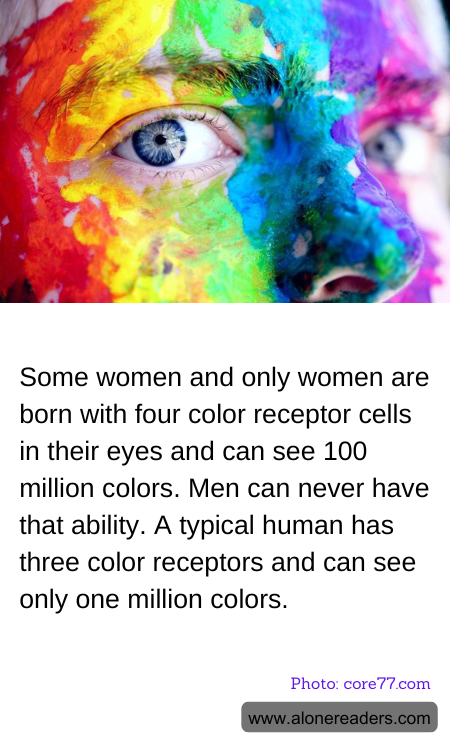
In the fascinating world of human vision, most people are familiar with the concept of the three primary colors—red, green, and blue—which combine in various ways to allow us to perceive a spectrum of about one million colors. This ability is due to the presence of three types of color receptor cells, or cones, in the human eye. However, a rare and intriguing phenomenon exists where some women possess a fourth type of cone, enabling them to see an astonishing 100 million colors. This condition, known as tetrachromacy, is a genetic trait that is exclusive to women, as men lack the genetic makeup necessary to develop this fourth receptor.
The science behind tetrachromacy is rooted in genetics. The genes responsible for the red and green cones are located on the X chromosome. Women have two X chromosomes, while men have one X and one Y chromosome. This genetic configuration means that women have the potential to carry a variation in one of their X chromosomes that can lead to the development of a fourth cone type. This additional cone allows for a broader range of color perception, as it can detect wavelengths of light that are invisible to the typical trichromatic vision.
While the concept of seeing 100 million colors might seem abstract, it has practical implications for those who possess this ability. Tetrachromats can distinguish subtle differences in shades and hues that are indistinguishable to the average person. This heightened perception can be particularly advantageous in fields that require acute color discrimination, such as art, design, and quality control in manufacturing. However, it is important to note that not all women with the genetic potential for tetrachromacy will develop the ability to perceive these additional colors. Environmental factors and the brain's processing capabilities also play a crucial role in the manifestation of this trait.
Despite its rarity, tetrachromacy has sparked significant interest and research within the scientific community. Studies aim to understand how this condition affects perception and whether it can be harnessed or enhanced in practical applications. Moreover, the existence of tetrachromacy challenges our understanding of human vision and highlights the incredible diversity of sensory experiences among individuals.
In conclusion, the phenomenon of tetrachromacy serves as a reminder of the complexity and wonder of human biology. While most of us navigate the world with a palette of one million colors, a select group of women experience a visual richness that is beyond the reach of the average eye. This unique ability not only underscores the genetic differences between men and women but also opens up new avenues for exploring the limits of human perception. As research continues, the potential applications and implications of tetrachromacy may reveal even more about the intricate tapestry of human vision.