More About This Card
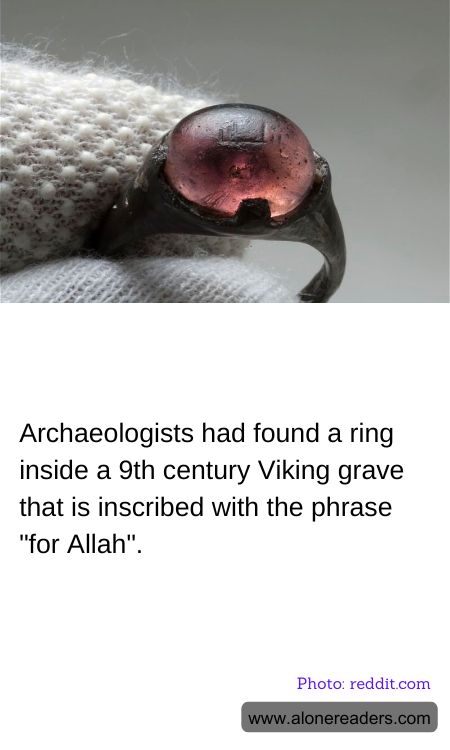
In a remarkable discovery that bridges cultures and centuries, archaeologists have unearthed a ring from a 9th-century Viking grave in Sweden, inscribed with the phrase "for Allah." This finding, which challenges conventional perceptions of Viking society, underscores the extensive trade networks and cultural exchanges between the Norsemen and the Islamic world during the early medieval period.
The ring was discovered at the burial site of a woman in the ancient trading town of Birka, a key hub in the Viking trade routes. Crafted from silver alloy and adorned with a violet-colored glass stone, the ring's Arabic inscription is a testament to the far-reaching connections that the Vikings established. The presence of such an inscription suggests that the Vikings were not only traders of goods but also carriers of ideas and cultural influences.
This discovery is significant as it provides tangible evidence of the interactions between the Vikings and the Islamic world. Historical records have long suggested that the Vikings traveled extensively, reaching as far as the Byzantine Empire and the Abbasid Caliphate. The ring, with its inscription, offers a glimpse into the personal exchanges that may have occurred during these voyages. It raises intriguing questions about the nature of these interactions, whether they were purely commercial or if they also involved deeper cultural and religious exchanges.
The inscription "for Allah" on the ring is particularly fascinating, as it indicates a level of respect or acknowledgment of the Islamic faith. While it is unlikely that the Vikings converted to Islam, the presence of such an inscription suggests that they were open to adopting elements from the cultures they encountered. This openness may have been driven by the Vikings' pragmatic approach to trade and diplomacy, where understanding and respecting different cultures could lead to more successful interactions.
Moreover, this finding contributes to a broader understanding of the Viking Age as a period of dynamic cultural exchange. It challenges the stereotypical image of Vikings as isolated marauders and highlights their role as active participants in a global network of trade and communication. The ring serves as a reminder of the interconnectedness of the medieval world, where ideas and beliefs could travel vast distances alongside goods and people.
In conclusion, the discovery of the ring inscribed with "for Allah" in a Viking grave is a testament to the rich tapestry of cultural interactions that characterized the Viking Age. It invites us to reconsider the complexity of Viking society and its interactions with the wider world. As archaeologists continue to uncover artifacts that shed light on these ancient connections, our understanding of history becomes more nuanced, revealing a world where diverse cultures intersected and influenced one another in profound ways.