More About This Card
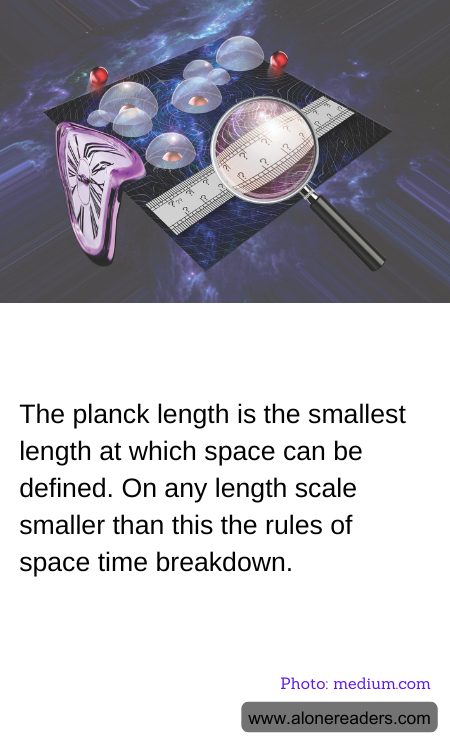
In the vast tapestry of the universe, where galaxies swirl and stars are born, there exists a concept so minuscule that it challenges our very understanding of space and time: the Planck length. This infinitesimal measure, approximately 1.616 x 10^-35 meters, represents the smallest conceivable unit of length. It is a scale at which the conventional laws of physics, as we know them, begin to unravel, and the familiar fabric of space-time becomes a frothy, unpredictable sea.
The Planck length emerges from the realm of quantum mechanics and general relativity, two pillars of modern physics that, despite their successes, often find themselves at odds. Quantum mechanics governs the microscopic world of particles, while general relativity describes the macroscopic world of gravity and the curvature of space-time. The Planck length is a bridge between these two worlds, a point where their equations converge, yet also where their harmony dissolves.
At scales larger than the Planck length, space-time behaves in a manner that is predictable and consistent with Einstein's theory of relativity. However, as we delve into scales smaller than this, the very notion of space and time becomes ambiguous. The smooth continuum of space-time, which allows us to measure distances and intervals, loses its meaning. Instead, space-time is thought to be a chaotic, quantum foam, where the classical ideas of geometry and distance cease to exist.
This breakdown of space-time at the Planck length is not just a theoretical curiosity but a profound insight into the limitations of our current understanding of the universe. It suggests that our classical concepts of space and time are emergent properties, arising from a deeper, more fundamental layer of reality that we have yet to fully comprehend. This has led physicists to explore theories such as string theory and loop quantum gravity, which attempt to unify quantum mechanics and general relativity and provide a coherent description of the universe at all scales.
The implications of the Planck length extend beyond the realm of theoretical physics. It challenges us to rethink our place in the cosmos and the nature of reality itself. It invites us to consider that the universe is not just a vast expanse of galaxies and stars but a complex, interconnected web of phenomena that operates on scales both unimaginably large and inconceivably small.
In contemplating the Planck length, we are reminded of the limits of human perception and understanding. It serves as a humbling testament to the mysteries that still lie beyond our grasp, urging us to continue exploring and questioning the universe. As we push the boundaries of knowledge, the Planck length stands as a beacon, guiding us toward a deeper, more unified understanding of the cosmos and our place within it.