More About This Card
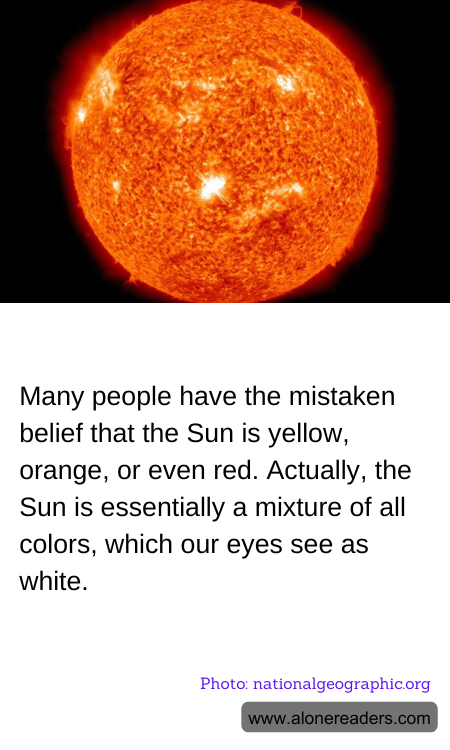
The Sun, our closest star and the center of our solar system, has long been a source of fascination and inspiration. Its radiant glow has been depicted in countless works of art and literature, often portrayed in hues of yellow, orange, or red. However, this common perception is a bit misleading. In reality, the Sun is not any single color but rather a combination of all colors, which our eyes perceive as white.
The misconception about the Sun's color arises primarily from the way we observe it from Earth. When the Sun is high in the sky, it appears white because its light travels a shorter path through the atmosphere. This shorter path means less scattering of light, allowing us to see the Sun's true color. However, during sunrise and sunset, the Sun appears more yellow, orange, or red. This is due to the longer path its light takes through the atmosphere at these times, which scatters shorter wavelengths like blue and green more than the longer red and orange wavelengths. This scattering effect, known as Rayleigh scattering, is the same reason the sky appears blue during the day.
The Sun emits light across the entire visible spectrum, and when combined, these colors create white light. This phenomenon can be demonstrated through a simple experiment using a prism. When sunlight passes through a prism, it is refracted and split into its constituent colors, creating a spectrum similar to a rainbow. This spectrum includes all the colors from violet to red, confirming that the Sun's light is indeed a mixture of all colors.
Understanding the true color of the Sun is not just a matter of scientific curiosity; it also has practical implications. For instance, the study of sunlight and its spectrum is crucial in fields such as astronomy and climate science. By analyzing the light from the Sun and other stars, scientists can determine their composition, temperature, and even their movement. This knowledge helps us understand not only our own solar system but also the broader universe.
Moreover, recognizing the Sun's true color can enhance our appreciation of the natural world. It reminds us of the complexity and beauty of the universe, where even something as seemingly simple as the color of the Sun is the result of intricate interactions between light and matter. This understanding encourages us to look beyond appearances and explore the underlying principles that govern the world around us.
In conclusion, while the Sun may often appear yellow, orange, or red to our eyes, it is, in essence, a brilliant white. This revelation invites us to reconsider our perceptions and embrace the wonders of science that reveal the true nature of our universe. Whether through a prism or a telescope, the Sun's light continues to illuminate not just our planet, but also our understanding of the cosmos.