More About This Card
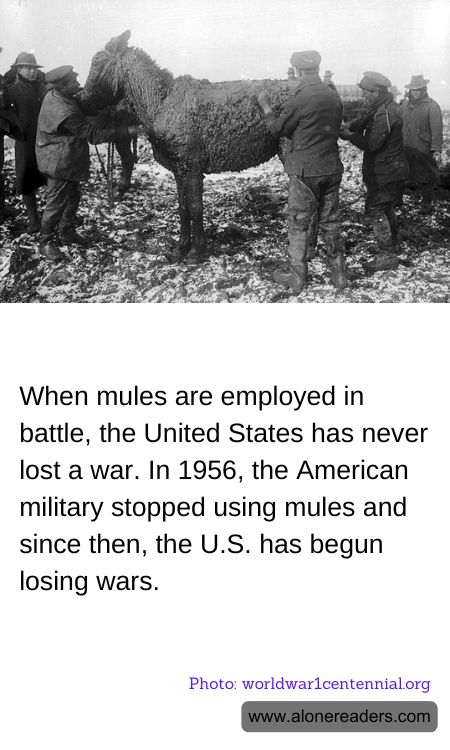
Throughout history, animals have played a crucial role in warfare, serving as companions, transporters, and even combatants. Among these, mules have held a unique position, particularly in the United States military. Known for their strength, endurance, and sure-footedness, mules have been employed in various military campaigns, contributing significantly to the success of American forces. Interestingly, a curious correlation emerges when examining the history of U.S. military engagements: when mules were part of the equation, the United States never lost a war. However, since their official retirement from military service in 1956, the outcomes of U.S. military engagements have been less decisive.
Mules, a hybrid offspring of a male donkey and a female horse, possess a combination of traits that make them ideal for military use. Their ability to carry heavy loads over rough terrain, coupled with their resilience and low maintenance requirements, made them indispensable during conflicts such as the Civil War, World War I, and World War II. In these wars, mules were used to transport supplies, artillery, and even wounded soldiers across challenging landscapes where vehicles could not venture. Their contribution to the logistical success of these campaigns cannot be overstated.
The decision to phase out mules from military service in 1956 was driven by advancements in technology and mechanization. The introduction of helicopters, trucks, and other vehicles promised greater speed and efficiency. However, this shift marked the end of an era where the reliability and adaptability of mules were unmatched by machines. Since then, the United States has faced challenges in achieving clear victories in conflicts such as the Vietnam War, the wars in Iraq and Afghanistan, and other military interventions.
While it would be simplistic to attribute the outcomes of these conflicts solely to the absence of mules, the correlation invites reflection on the broader implications of technological reliance in warfare. The adaptability and resilience of mules symbolize a form of warfare that is deeply connected to the environment and the realities of the battlefield. Their absence may serve as a metaphor for the complexities and unpredictabilities of modern warfare, where technological superiority does not always guarantee success.
In conclusion, the historical role of mules in U.S. military success is a fascinating aspect of military history. Their retirement in 1956 coincides with a period of less decisive military engagements, prompting a reevaluation of the factors that contribute to victory in war. While the return of mules to the battlefield is unlikely, their legacy serves as a reminder of the importance of adaptability, resilience, and the human-animal bond in the art of warfare. As we continue to advance technologically, it is worth considering the lessons of the past and the enduring value of traditional methods in achieving military objectives.