More About This Card
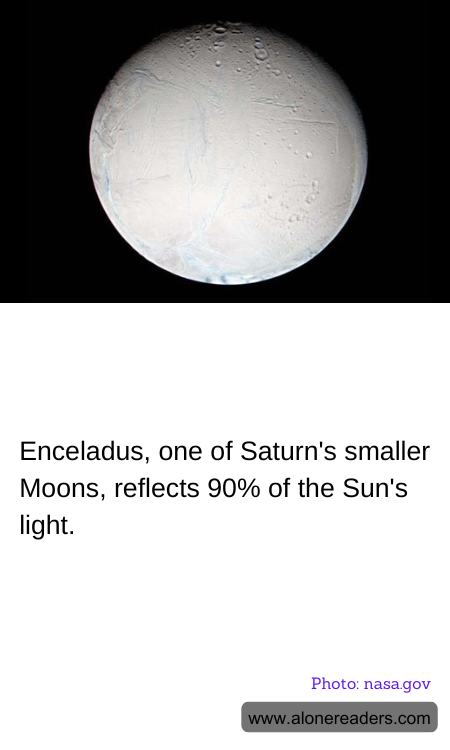
Enceladus, a captivating celestial body orbiting Saturn, has intrigued scientists and space enthusiasts alike with its remarkable ability to reflect 90% of the Sun's light. This small moon, with a diameter of just about 504 kilometers, is one of the most reflective objects in our solar system. Its high albedo, or reflectivity, is primarily due to its icy surface, which is constantly replenished by geysers that spew water vapor and ice particles from its subsurface ocean.
The discovery of Enceladus's reflective nature was made possible by the Cassini spacecraft, which orbited Saturn from 2004 to 2017. Cassini's observations revealed that Enceladus's surface is covered in fresh, clean ice, making it a giant mirror in space. This reflective quality not only makes Enceladus a brilliant object in the night sky but also provides crucial insights into its geological activity and potential for harboring life.
The geysers on Enceladus are a fascinating phenomenon. They erupt from the moon's south polar region, where large fractures known as "tiger stripes" are located. These geysers eject plumes of water vapor, ice particles, and organic compounds into space, contributing to Saturn's E-ring and continuously resurfacing Enceladus with fresh ice. This process keeps the moon's surface bright and reflective, unlike many other celestial bodies that become darker over time due to space weathering.
Enceladus's reflective surface is more than just a visual spectacle; it is a window into the moon's potential habitability. The presence of a subsurface ocean beneath its icy crust raises the possibility of microbial life existing in its depths. The heat generated by tidal forces from Saturn's gravitational pull keeps this ocean in a liquid state, creating an environment that could support life as we know it. The organic compounds found in the plumes further suggest that Enceladus has the necessary ingredients for life.
The study of Enceladus continues to be a priority for scientists, as it holds the promise of answering fundamental questions about the potential for life beyond Earth. Future missions to this icy moon could provide more detailed information about its ocean, the composition of its plumes, and the possibility of life. Enceladus's ability to reflect sunlight not only makes it a stunning object in the cosmos but also a beacon of hope in the search for extraterrestrial life. As we continue to explore the wonders of our solar system, Enceladus remains a shining example of the mysteries that await discovery.