More About This Card
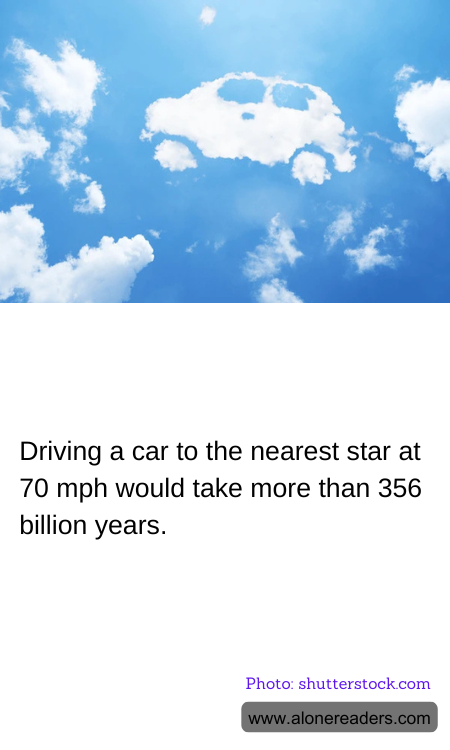
Imagine embarking on a road trip to the nearest star beyond our sun, Proxima Centauri, which is approximately 4.24 light-years away. While this might sound like an exciting adventure, the reality of such a journey is mind-boggling. If you were to drive a car at a constant speed of 70 miles per hour, it would take more than 356 billion years to reach this distant star. This staggering figure highlights the vastness of our universe and the limitations of our current technology when it comes to interstellar travel.
To put this into perspective, consider the age of the universe, which is estimated to be around 13.8 billion years. The time it would take to drive to Proxima Centauri is more than 25 times the age of the universe itself. This comparison underscores the immense distances between celestial bodies and the challenges faced by scientists and engineers in developing feasible methods for space exploration beyond our solar system.
The concept of driving to a star at 70 mph serves as a thought experiment to illustrate the limitations of conventional travel methods in the context of space. Cars, which are designed for terrestrial travel, are not equipped to handle the vacuum of space or the absence of roads. Moreover, the energy requirements and life support systems necessary for such a prolonged journey are beyond our current capabilities. This thought experiment also emphasizes the need for innovative propulsion technologies, such as those being explored by space agencies and private companies, to make interstellar travel a reality.
Despite the seemingly insurmountable challenges, the idea of reaching the stars continues to captivate the human imagination. Scientists are actively researching advanced propulsion systems, such as ion drives, nuclear propulsion, and even theoretical concepts like warp drives, which could potentially reduce travel times to a fraction of what they would be using conventional methods. These technologies, while still in their infancy, offer hope for future generations to explore the cosmos beyond our solar neighborhood.
In the meantime, humanity's quest to understand the universe continues through other means, such as powerful telescopes and robotic spacecraft that provide valuable data about distant stars and planets. These tools allow us to study the cosmos from afar, expanding our knowledge and inspiring future explorers who may one day embark on journeys to the stars.
The notion of driving to the nearest star at 70 mph serves as a humbling reminder of the vastness of space and the challenges that lie ahead in our quest to explore it. While the journey may be impossible with today's technology, the dream of reaching the stars remains a powerful motivator for scientific discovery and innovation. As we continue to push the boundaries of what is possible, who knows what the future may hold for humanity's place among the stars?