More About This Card
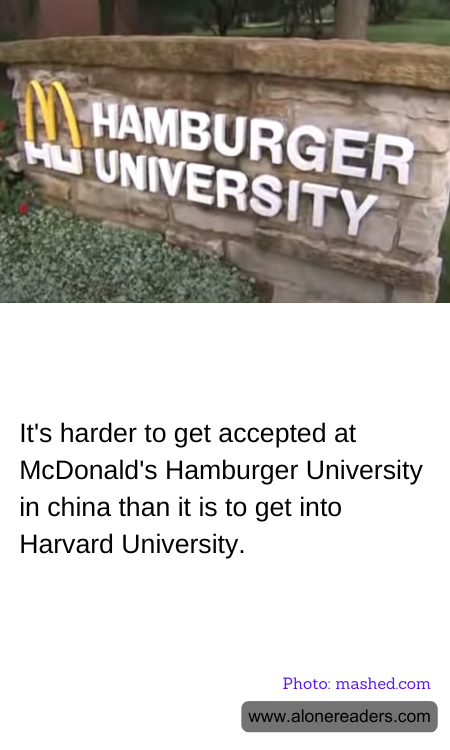
In the realm of higher education, Harvard University is often regarded as the pinnacle of academic achievement, with its rigorous selection process and prestigious reputation. However, an unexpected contender has emerged in the competitive world of admissions: McDonald's Hamburger University in China. Surprisingly, gaining entry into this unique institution is statistically more challenging than securing a spot at Harvard.
Hamburger University, established by McDonald's in 1961, serves as the company's global training center, offering courses in restaurant management, operations, and leadership. With campuses in several countries, the Shanghai branch has gained particular notoriety for its exclusivity. Each year, thousands of applicants vie for a limited number of spots, making the acceptance rate staggeringly low. In contrast, Harvard's acceptance rate, while notoriously competitive, is slightly more forgiving.
The allure of Hamburger University lies in its promise of career advancement within one of the world's largest fast-food chains. Graduates are equipped with the skills and knowledge necessary to climb the corporate ladder, often leading to lucrative positions within McDonald's. This career trajectory is particularly appealing in China, where the fast-food industry is booming, and opportunities for growth are abundant. As a result, the university attracts a diverse pool of applicants, ranging from recent graduates to seasoned professionals seeking to enhance their credentials.
The rigorous selection process at Hamburger University involves a comprehensive evaluation of candidates' leadership potential, problem-solving abilities, and commitment to the brand's values. Applicants undergo a series of interviews and assessments designed to identify those who possess the qualities necessary to thrive in a fast-paced, customer-focused environment. This meticulous approach ensures that only the most dedicated and capable individuals are granted admission.
While the comparison to Harvard may seem surprising, it underscores the evolving landscape of education and career development. In a world where traditional academic institutions are no longer the sole arbiters of success, alternative pathways like Hamburger University offer valuable opportunities for personal and professional growth. For many, the chance to learn from industry leaders and gain hands-on experience in a dynamic field is an attractive proposition, even if it means facing stiff competition.
Ultimately, the challenge of gaining acceptance to Hamburger University in China highlights the growing importance of vocational training and specialized education in today's global economy. As industries continue to evolve, institutions like Hamburger University play a crucial role in preparing the next generation of leaders, proving that the path to success is not always paved with ivy-covered walls.