More About This Card
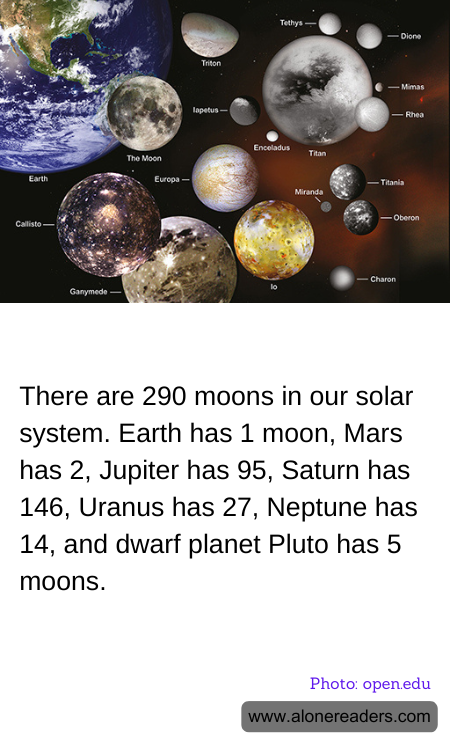
The solar system, a vast and intriguing expanse, is home to a diverse array of celestial bodies, including a remarkable collection of moons. These natural satellites, orbiting the planets, add to the wonder and complexity of our cosmic neighborhood. As of now, there are 290 known moons in our solar system, each with its own unique characteristics and stories to tell.
Earth, our home planet, has a single moon, often simply referred to as "the Moon." This celestial companion has been a source of fascination and inspiration for humanity throughout history. Its phases have guided calendars, its surface has been explored by astronauts, and its presence influences Earth's tides, playing a crucial role in the natural rhythms of our planet.
Mars, the fourth planet from the Sun, has two small moons named Phobos and Deimos. These irregularly shaped bodies are thought to be captured asteroids, and their proximity to Mars makes them intriguing targets for scientific study. Despite their diminutive size, they offer valuable insights into the history and evolution of the Martian system.
Jupiter, the largest planet in our solar system, boasts an impressive 95 moons. Among them are the four largest, known as the Galilean moons: Io, Europa, Ganymede, and Callisto. Discovered by Galileo Galilei in 1610, these moons are diverse worlds in their own right, with Ganymede being the largest moon in the solar system. Each of these moons presents unique geological features and potential for scientific discovery, particularly Europa, which is believed to harbor a subsurface ocean.
Saturn, famous for its stunning rings, surpasses Jupiter with a total of 146 moons. Titan, the largest of Saturn's moons, is particularly noteworthy. It is the only moon in the solar system with a dense atmosphere and liquid bodies on its surface, making it a prime candidate for the study of prebiotic chemistry and the potential for life. The sheer number and diversity of Saturn's moons continue to captivate astronomers and planetary scientists.
Uranus, the ice giant, has 27 known moons. These moons are named after characters from the works of William Shakespeare and Alexander Pope, adding a touch of literary charm to their celestial presence. Neptune, the outermost planet, has 14 moons, with Triton being the largest. Triton is unique for its retrograde orbit, suggesting it may have been captured by Neptune's gravity, and it remains a subject of interest due to its geologically active surface.
Even the dwarf planet Pluto, once considered the ninth planet, has its own collection of moons. Pluto's five moons, including the largest, Charon, form a fascinating system that challenges our understanding of planetary formation and dynamics.
The moons of our solar system are more than mere satellites; they are dynamic worlds that offer a glimpse into the processes that shaped our cosmic neighborhood. As technology advances and exploration continues, these moons hold the promise of unlocking secrets about the origins and evolution of our solar system, inviting us to look beyond our own planet and embrace the wonders of the universe.