More About This Card
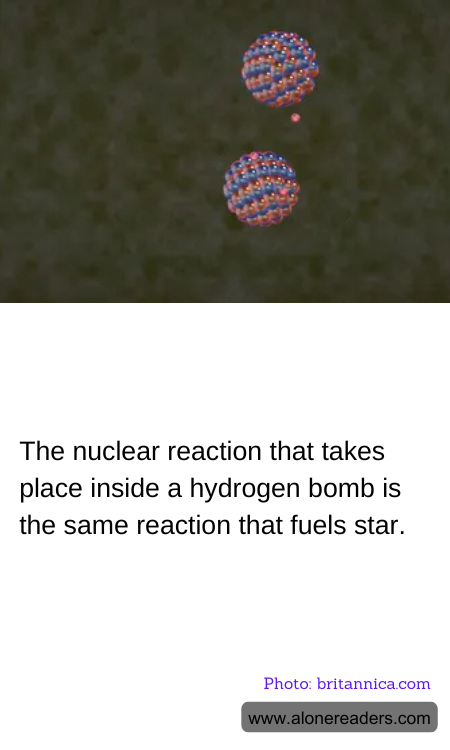
The nuclear reaction that powers a hydrogen bomb is the same fundamental process that fuels the stars, including our sun. This reaction is known as nuclear fusion, a process where two light atomic nuclei combine to form a heavier nucleus, releasing a tremendous amount of energy. In the case of both stars and hydrogen bombs, the primary fuel is isotopes of hydrogen, typically deuterium and tritium.
In the heart of a star, immense gravitational pressure and high temperatures create the perfect environment for nuclear fusion. The core of a star is incredibly hot, with temperatures reaching millions of degrees Celsius. Under these extreme conditions, hydrogen nuclei move at such high speeds that they can overcome their natural repulsion and collide with enough force to fuse together. This fusion process releases energy in the form of light and heat, which is why stars shine so brightly. The energy produced by fusion in stars is what provides the heat and light necessary to sustain life on planets like Earth.
A hydrogen bomb, or thermonuclear bomb, replicates this natural process but on a much shorter timescale and with far more destructive intent. The bomb uses a fission reaction, typically involving uranium or plutonium, to create the extreme temperatures and pressures necessary to initiate fusion. Once the fusion reaction begins, it releases an enormous amount of energy in a fraction of a second, resulting in a massive explosion. The energy released by a hydrogen bomb is many times greater than that of a traditional atomic bomb, which relies solely on fission.
While the fundamental process of nuclear fusion is the same in both stars and hydrogen bombs, the contexts and outcomes are vastly different. In stars, fusion is a continuous and controlled process that can last billions of years, providing a stable source of energy. In contrast, a hydrogen bomb is designed to release energy in an uncontrolled and instantaneous manner, resulting in catastrophic destruction.
The study of nuclear fusion has also inspired efforts to harness this process for peaceful purposes. Scientists around the world are working on developing fusion reactors that could provide a nearly limitless source of clean energy. Unlike fission reactors, which produce long-lived radioactive waste, fusion reactors would produce minimal waste and no greenhouse gases. If successful, fusion energy could revolutionize the way we power our world, offering a sustainable and environmentally friendly alternative to fossil fuels.
In summary, while the nuclear fusion process is a shared characteristic of both stars and hydrogen bombs, the implications of this reaction are profoundly different. Stars use fusion to sustain life, while hydrogen bombs demonstrate the destructive potential of this powerful natural process. The ongoing pursuit of controlled nuclear fusion for energy purposes holds the promise of harnessing this stellar power for the benefit of humanity.