More About This Card
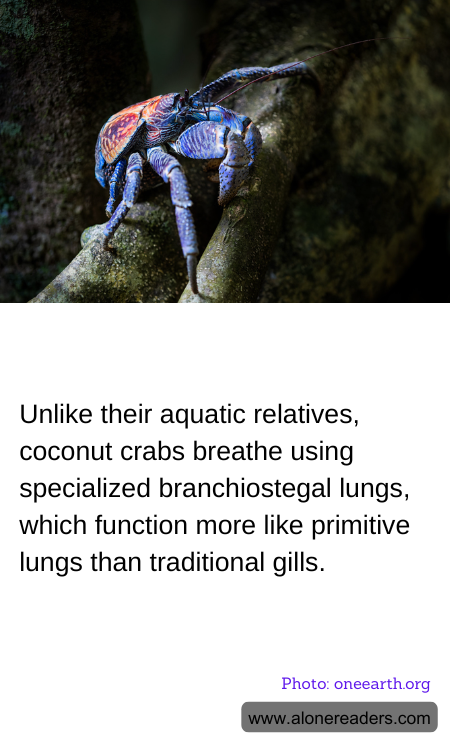
Coconut crabs, the largest terrestrial arthropods in the world, are fascinating creatures that have adapted remarkably well to life on land. Unlike their aquatic relatives, such as crabs and lobsters, coconut crabs have evolved a unique respiratory system that allows them to thrive outside of water. This adaptation is crucial for their survival and sets them apart from other crustaceans.
The key to the coconut crab's terrestrial lifestyle lies in its specialized branchiostegal lungs. These organs are a fascinating blend of gills and lungs, functioning more like primitive lungs than the traditional gills found in their aquatic counterparts. While gills are designed to extract oxygen from water, branchiostegal lungs are adapted to absorb oxygen from the air. This adaptation is essential for coconut crabs, as they spend most of their lives on land, only returning to the sea to lay eggs.
Branchiostegal lungs are located in the crab's thoracic cavity and are lined with a highly vascularized membrane. This membrane allows for efficient gas exchange, enabling the crab to breathe air. The structure of these lungs is quite different from the gills of aquatic crabs, which are feathery and designed to maximize surface area for oxygen absorption in water. In contrast, the branchiostegal lungs of coconut crabs are more compact and better suited for extracting oxygen from the air.
This unique respiratory system allows coconut crabs to explore a variety of terrestrial habitats, from coastal areas to inland forests. Their ability to breathe air gives them access to a diverse range of food sources, including fruits, nuts, and even small animals. Coconut crabs are particularly known for their strength and dexterity, which they use to crack open coconuts, a feat that few other animals can accomplish.
Despite their impressive adaptations, coconut crabs are still dependent on water to some extent. They must keep their branchiostegal lungs moist to function properly, which is why they are often found in humid environments or near water sources. Additionally, coconut crabs return to the ocean to release their eggs, which hatch into aquatic larvae before eventually transitioning to land.
The evolution of branchiostegal lungs in coconut crabs is a remarkable example of how organisms can adapt to new environments. By developing a respiratory system that functions more like primitive lungs than traditional gills, coconut crabs have carved out a unique niche in the animal kingdom. Their ability to thrive on land while maintaining a connection to their aquatic origins is a testament to the incredible diversity and adaptability of life on Earth.