More About This Card
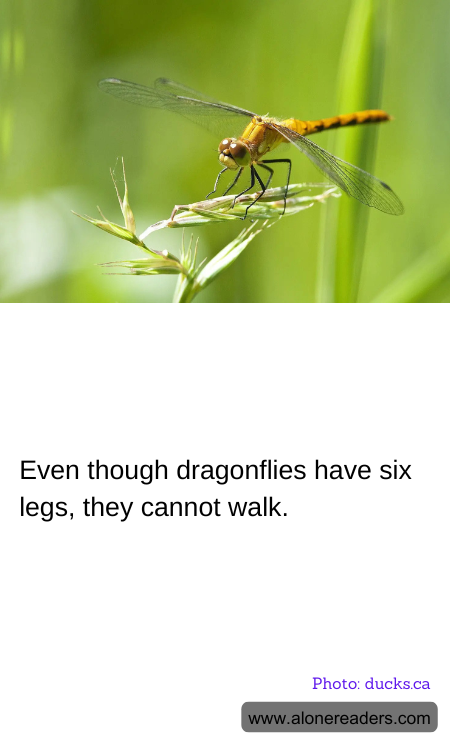
Dragonflies are among the most fascinating insects in the natural world, captivating observers with their vibrant colors and agile flight. Despite their six-legged anatomy, a characteristic they share with other insects, dragonflies are unique in that they cannot walk. This intriguing aspect of their biology raises questions about the evolutionary adaptations that have shaped these remarkable creatures.
The inability of dragonflies to walk is primarily due to the structure and function of their legs. Unlike many insects that use their legs for locomotion on land, dragonflies have legs that are adapted for capturing prey and perching. Their legs are positioned in such a way that they form a basket-like structure, which is highly effective for snatching insects out of the air. This adaptation is crucial for their survival, as dragonflies are voracious predators that rely on their aerial hunting skills to catch mosquitoes, flies, and other small insects.
The legs of a dragonfly are long and spindly, equipped with spines that help them grasp their prey securely. While these legs are perfect for hunting and perching, they are not designed to support the body for walking. The muscles and joints in dragonfly legs are not structured to facilitate the coordinated movement required for walking. Instead, dragonflies are built for flight, with powerful wings that allow them to hover, dart, and change direction with incredible speed and precision.
Dragonflies spend most of their lives in the air, where they are most adept. Their flight capabilities are among the most advanced in the insect world, with some species capable of flying at speeds of up to 30 miles per hour. This aerial prowess compensates for their inability to walk, allowing them to escape predators, find mates, and explore vast areas in search of food. When they do land, dragonflies typically perch on vegetation or other surfaces, using their legs to hold on rather than to move around.
The evolutionary trade-off that dragonflies have made—sacrificing the ability to walk for enhanced flight and hunting capabilities—demonstrates the diverse strategies that different species have developed to thrive in their environments. While it might seem like a limitation, the dragonfly's inability to walk is a testament to the specialization that has allowed them to become one of nature's most efficient aerial hunters.
In conclusion, the dragonfly's six legs are a marvel of evolutionary design, perfectly suited to their lifestyle as aerial predators. Their inability to walk is not a disadvantage but rather a reflection of their specialization for life in the air. This unique adaptation highlights the incredible diversity of life on Earth and the myriad ways in which organisms have evolved to meet the challenges of survival. Whether admired for their beauty or their ecological role, dragonflies continue to inspire wonder and curiosity in people of all ages.