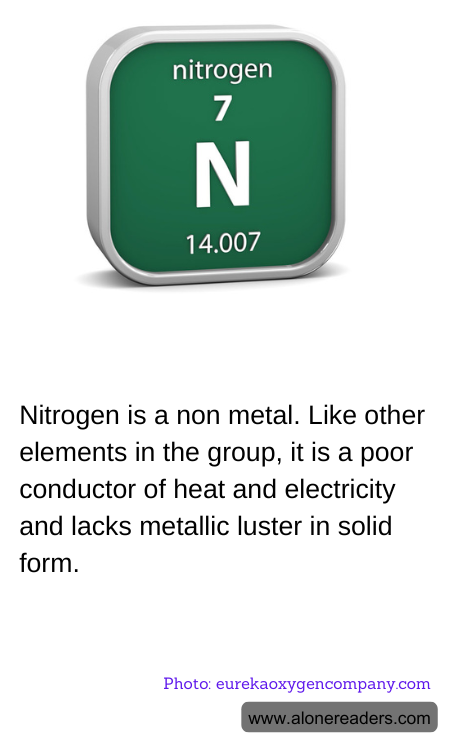
More About This Card
Nitrogen, a fundamental element in the periodic table, is classified as a non-metal. It is a crucial component of the Earth's atmosphere, making up approximately 78% of the air we breathe. Despite its abundance, nitrogen often goes unnoticed because it is colorless, odorless, and tasteless in its gaseous form. However, its properties and significance extend far beyond its presence in the air.
As a non-metal, nitrogen exhibits characteristics that distinguish it from metals. One of the most notable features of non-metals, including nitrogen, is their poor conductivity of heat and electricity. This is due to the lack of free electrons, which are necessary for conducting electricity. In metals, these free electrons move easily, allowing for efficient energy transfer. In contrast, nitrogen's electrons are tightly bound in covalent bonds, preventing the free flow of electrical current. This property makes nitrogen and other non-metals unsuitable for applications that require electrical conductivity.
In its solid form, nitrogen also lacks the metallic luster that is typically associated with metals. This absence of shine is another hallmark of non-metals. While metals are often shiny and reflective due to their electron structure, non-metals like nitrogen do not reflect light in the same way. This results in a dull appearance, which is why solid nitrogen, when it can be observed, does not exhibit the gleaming surface characteristic of metals.
Despite these differences, nitrogen plays an indispensable role in various biological and industrial processes. It is a key component of amino acids, which are the building blocks of proteins, and nucleic acids, which form the genetic material of all living organisms. This makes nitrogen essential for life, as it is involved in the growth and repair of tissues. In agriculture, nitrogen is a critical nutrient for plants, often supplied through fertilizers to enhance crop yields.
Industrially, nitrogen is used in a variety of applications. It is employed in the production of ammonia through the Haber-Bosch process, which is a precursor to many fertilizers. Additionally, nitrogen is used as a protective gas in food packaging to prevent oxidation and spoilage, and in the electronics industry, it is used to create an inert atmosphere during the manufacturing of semiconductors.
In summary, while nitrogen may lack the conductive and lustrous properties of metals, its role in nature and industry is undeniably significant. Its unique characteristics as a non-metal make it an essential element in both biological systems and technological applications. Understanding nitrogen's properties helps us appreciate its importance and the diverse ways it contributes to life on Earth.