More About This Card
In the realm of scientific discovery, serendipity often plays a pivotal role, leading to groundbreaking innovations that transform our daily lives. One such serendipitous invention is Wi-Fi, a technology that has become indispensable in the modern world. The story of Wi-Fi's inception is a fascinating tale of how a quest to explore the cosmos inadvertently led to the creation of a technology that connects billions of people today.
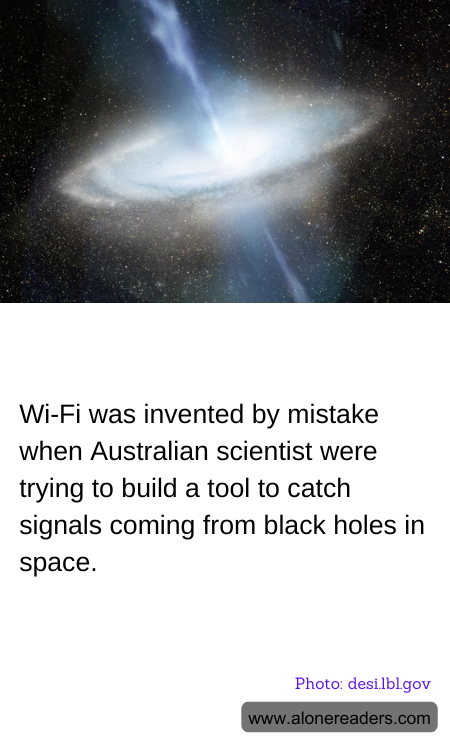
In the early 1990s, a team of Australian scientists at the Commonwealth Scientific and Industrial Research Organisation (CSIRO) embarked on an ambitious project to detect the faintest of signals emanating from black holes in space. The team, led by Dr. John O'Sullivan, was focused on developing a tool that could capture these elusive signals, which required the ability to filter out background noise and interference. This task was no small feat, as the signals from black holes are incredibly weak and easily drowned out by other cosmic noise.
As the scientists delved deeper into their research, they encountered numerous challenges. The key obstacle was the need to refine the process of signal detection, which involved complex mathematical algorithms. It was during this process that Dr. O'Sullivan and his team stumbled upon a method that could reduce interference in wireless transmissions. This breakthrough was not initially recognized for its potential beyond the realm of astrophysics, but it laid the foundation for what would eventually become Wi-Fi technology.
The accidental discovery of this interference-reducing method was a turning point. The team realized that their findings could have significant applications in the field of wireless communication. By applying their newfound technique, they could enhance the clarity and reliability of wireless data transmission, paving the way for the development of Wi-Fi. This technology would soon revolutionize the way people access the internet, enabling wireless connectivity in homes, offices, and public spaces around the globe.
Wi-Fi's journey from a cosmic exploration tool to a household necessity is a testament to the unpredictable nature of scientific research. It highlights the importance of curiosity-driven exploration and the potential for unexpected outcomes to yield transformative technologies. Today, Wi-Fi is an integral part of our daily lives, facilitating everything from remote work and online education to streaming entertainment and smart home devices.
The story of Wi-Fi's accidental invention serves as a reminder of the interconnectedness of scientific disciplines and the potential for cross-disciplinary breakthroughs. It underscores the value of investing in scientific research, even when the immediate applications are not apparent. As we continue to explore the universe and push the boundaries of human knowledge, who knows what other accidental inventions might emerge, forever changing the way we live and interact with the world around us.