More About This Card
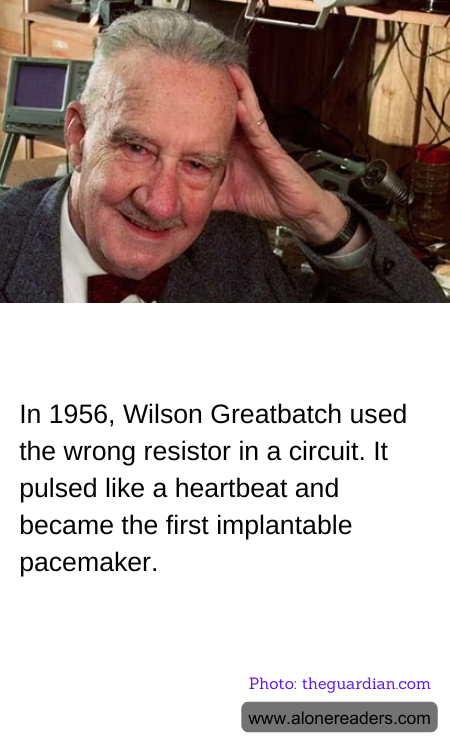
In the annals of medical innovation, serendipity has often played a pivotal role. One such instance occurred in 1956 when Wilson Greatbatch, an American engineer, inadvertently laid the groundwork for a life-saving device that would transform cardiac care. While working on a project at the University of Buffalo, Greatbatch made what seemed like a simple mistake: he inserted the wrong resistor into an experimental circuit. This error, however, led to an unexpected discovery that would change the course of medical history.
The circuit, intended for a heart rhythm recording device, began to emit a rhythmic electrical pulse. This pulse mimicked the natural beat of the human heart, sparking an idea in Greatbatch's mind. He realized that this accidental creation could potentially be used to regulate heartbeats in patients with arrhythmias, a condition where the heart beats irregularly. At the time, external pacemakers existed, but they were cumbersome and required patients to be tethered to large machines. The prospect of creating a small, implantable device was revolutionary.
Greatbatch's insight and determination led him to refine his accidental invention into the first implantable pacemaker. Collaborating with Dr. William Chardack, a surgeon, and Dr. Andrew Gage, a medical researcher, Greatbatch developed a prototype that could be safely implanted into the human body. In 1960, the first successful implantation of the pacemaker was performed on a patient, marking a significant milestone in medical technology. This device not only extended the lives of countless individuals but also improved their quality of life by allowing them to live more freely and independently.
The impact of Greatbatch's invention cannot be overstated. Today, millions of people around the world rely on pacemakers to maintain a regular heartbeat. The device has undergone numerous advancements since its inception, becoming smaller, more efficient, and more reliable. Modern pacemakers can be programmed to adjust to the body's needs, providing a personalized approach to cardiac care. This evolution is a testament to the enduring legacy of Greatbatch's serendipitous discovery.
Wilson Greatbatch's story is a powerful reminder of the potential for unexpected discoveries to lead to groundbreaking innovations. His journey from a simple mistake to a life-saving invention underscores the importance of curiosity, perseverance, and the willingness to explore the unknown. As we continue to push the boundaries of science and technology, Greatbatch's pacemaker serves as an inspiring example of how a single moment of chance can lead to a lifetime of change.