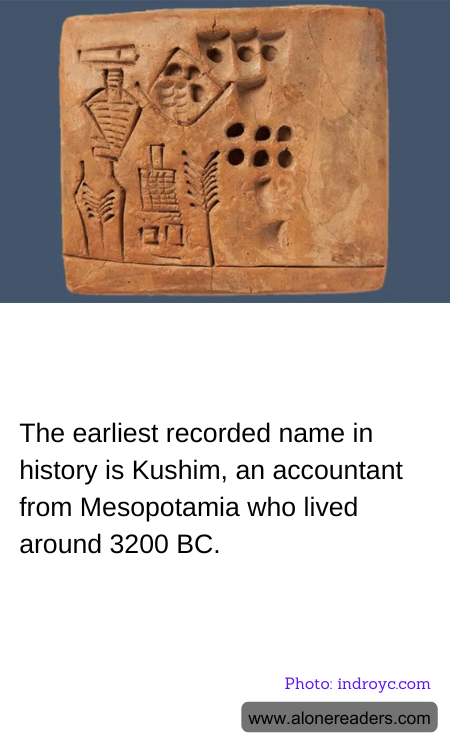
More About This Card
In the annals of human history, names have always held a special significance, serving as identifiers and bearers of identity. Among the earliest recorded names, one stands out for its simplicity and historical importance: Kushim. This name, etched into clay tablets from ancient Mesopotamia, represents not just an individual but a glimpse into the dawn of recorded history and the evolution of human civilization.
Kushim lived around 3200 BC in the region known today as Iraq, during a time when writing was in its infancy. The name appears on a series of clay tablets discovered in the ancient city of Uruk, one of the world's first major urban centers. These tablets, inscribed with cuneiform script, are not tales of heroism or myth but rather mundane records of economic transactions. Kushim was an accountant, a role that underscores the practical origins of writing as a tool for administration and trade.
The significance of Kushim's name lies in its context. At a time when societies were transitioning from small agrarian communities to complex urban centers, the need for record-keeping became paramount. The tablets bearing Kushim's name detail the management of barley, a staple crop, and the transactions associated with it. This indicates that Kushim was responsible for overseeing the distribution and accounting of resources, a crucial task in a burgeoning city-state.
The presence of Kushim's name on these tablets highlights the role of writing as a revolutionary development in human history. It marked a shift from oral traditions to a system where information could be recorded, stored, and transmitted across generations. This advancement laid the groundwork for the development of literature, law, and science, fundamentally transforming human society.
Kushim's legacy, though seemingly modest, is profound. It reminds us that the roots of civilization are deeply intertwined with the need for organization and communication. The fact that the earliest recorded name belongs to an accountant rather than a king or warrior speaks volumes about the priorities of early societies. It underscores the importance of economic stability and resource management as foundations for growth and development.
Today, as we navigate a world driven by data and information, the story of Kushim serves as a reminder of our shared human journey. It connects us to a time when the written word was just beginning to shape the course of history. Kushim's name, preserved through millennia, is a testament to the enduring power of writing and the timeless nature of human enterprise.