More About This Card
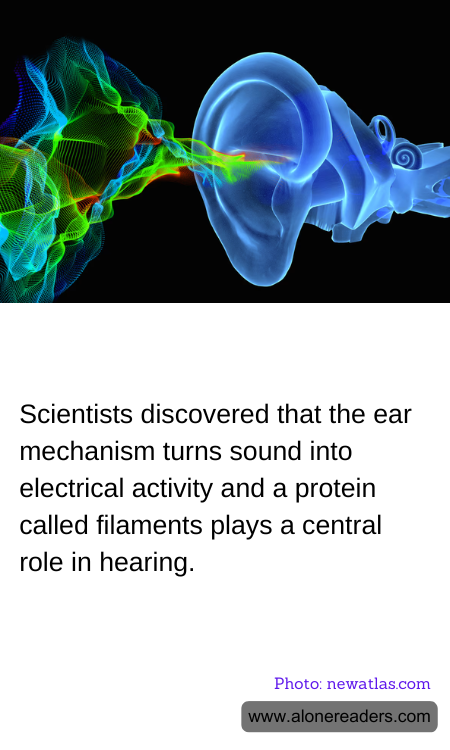
In a groundbreaking discovery, scientists have unveiled the intricate process by which our ears convert sound waves into electrical signals, shedding light on the central role played by a protein known as filaments in the hearing mechanism. This revelation not only deepens our understanding of auditory biology but also opens new avenues for addressing hearing impairments.
The human ear is a marvel of biological engineering, capable of detecting a vast range of sounds and frequencies. At the heart of this process is the cochlea, a spiral-shaped organ within the inner ear. When sound waves enter the ear, they travel through the ear canal, causing the eardrum to vibrate. These vibrations are then transmitted through the tiny bones of the middle ear to the cochlea. Inside the cochlea, the vibrations create waves in the fluid-filled chambers, which in turn stimulate tiny hair cells.
These hair cells are equipped with microscopic hair-like projections called stereocilia. It is here that the protein filaments play a pivotal role. Filaments are thread-like proteins that connect the tips of the stereocilia. When sound-induced vibrations cause the stereocilia to move, the filaments stretch and open ion channels in the hair cells. This action allows ions to flow into the cells, generating an electrical signal. This electrical activity is then transmitted to the brain via the auditory nerve, where it is interpreted as sound.
The discovery of filaments' role in hearing is a significant advancement in auditory science. Researchers have long been aware of the mechanical-to-electrical conversion in the ear, but the precise molecular mechanisms were not fully understood. By identifying filaments as a key component in this process, scientists can now explore new strategies for treating hearing loss. Many forms of hearing impairment are linked to damage or dysfunction in the hair cells or their associated structures. Understanding the role of filaments could lead to innovative therapies aimed at repairing or regenerating these critical components.
Moreover, this discovery has broader implications for the field of sensory biology. The mechanisms by which mechanical stimuli are converted into electrical signals are not unique to hearing; similar processes occur in other sensory systems, such as touch and balance. Insights gained from studying filaments in the auditory system could therefore enhance our understanding of these other senses as well.
In conclusion, the identification of filaments as a central player in the ear's conversion of sound into electrical activity marks a significant milestone in auditory research. This finding not only enriches our knowledge of how we perceive sound but also holds promise for developing new treatments for hearing loss. As scientists continue to unravel the complexities of the ear's mechanisms, we move closer to a future where hearing impairments can be more effectively managed or even reversed, improving the quality of life for millions worldwide.