More About This Card
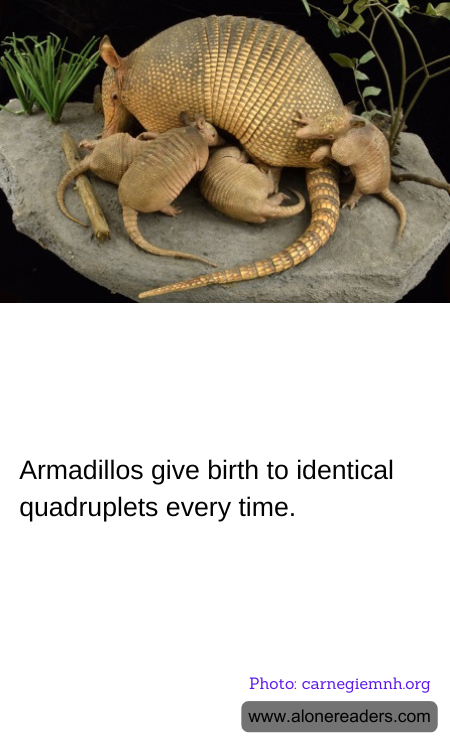
Armadillos are fascinating creatures that have captured the curiosity of scientists and nature enthusiasts alike. One of the most intriguing aspects of these armored mammals is their unique reproductive process, which consistently results in the birth of identical quadruplets. This remarkable phenomenon is not only a testament to the wonders of nature but also provides valuable insights into the biology and evolution of these enigmatic animals.
The nine-banded armadillo, the most widespread species in the Americas, is particularly known for this extraordinary reproductive trait. Unlike most mammals, where each offspring is genetically distinct, armadillos give birth to four genetically identical young from a single fertilized egg. This process, known as polyembryony, is rare among mammals and adds a layer of intrigue to the study of armadillos. The fertilized egg splits into four separate embryos early in development, ensuring that each offspring shares the same genetic makeup.
This reproductive strategy offers several advantages. By producing identical quadruplets, armadillos can efficiently pass on their genetic material, ensuring that their successful traits are preserved in the next generation. This can be particularly beneficial in stable environments where the armadillo's adaptations are well-suited to survival. Additionally, the uniformity of the offspring may simplify parental investment, as the mother can provide care and resources to a group of young that all have the same needs and developmental stages.
The birth of identical quadruplets also raises intriguing questions about the evolutionary pressures that led to this unique reproductive strategy. Some scientists speculate that it may be an adaptation to the armadillo's environment, where the ability to quickly produce multiple offspring could be advantageous in the face of predation or environmental challenges. Others suggest that it could be a byproduct of the armadillo's relatively low metabolic rate and long gestation period, which might favor the development of multiple embryos from a single fertilization event.
Beyond its scientific implications, the armadillo's reproductive process captivates the imagination and highlights the diversity of life on Earth. It serves as a reminder of the myriad ways in which animals have adapted to their environments and the complex interplay of genetics and evolution. For those fortunate enough to observe these creatures in the wild, the sight of a mother armadillo with her identical young is a testament to the resilience and ingenuity of nature.
In conclusion, the armadillo's ability to give birth to identical quadruplets is a fascinating example of nature's creativity and adaptability. This unique reproductive strategy not only ensures the survival of the species but also provides a window into the complex mechanisms of evolution. As we continue to study these remarkable animals, we gain a deeper appreciation for the intricate tapestry of life and the endless possibilities it holds.