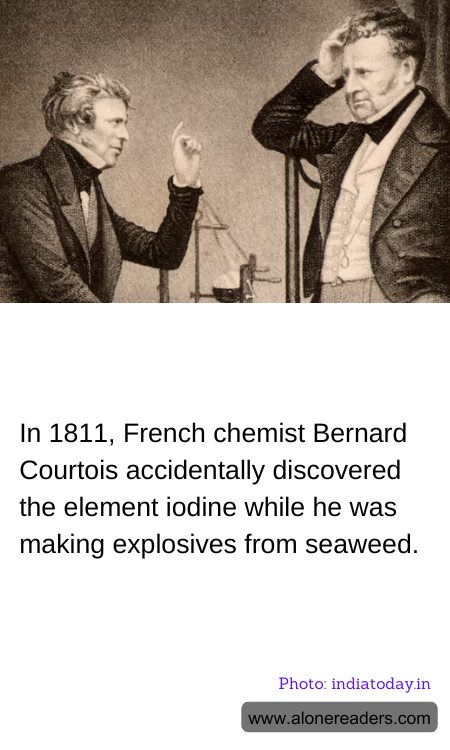
More About This Card
In the early 19th century, the world of chemistry was a burgeoning field of discovery and innovation. Among the many serendipitous findings of this era was the accidental discovery of iodine by French chemist Bernard Courtois in 1811. This discovery not only expanded the periodic table but also had significant implications for medicine and industry.
Bernard Courtois was born into a family deeply involved in the saltpeter industry, a key component in the production of gunpowder. During the Napoleonic Wars, there was a high demand for gunpowder, prompting Courtois to explore alternative sources of potassium nitrate, a crucial ingredient. Seaweed, abundant along the French coast, became a focal point for his experiments due to its high potassium content.
In his laboratory, Courtois was processing seaweed ash to extract sodium and potassium compounds. During one of these routine experiments, he added sulfuric acid to the seaweed ash, expecting to produce potassium nitrate. However, an unexpected reaction occurred, releasing a violet vapor. This vapor condensed into dark crystals on cooler surfaces. Intrigued by this unforeseen result, Courtois conducted further tests and realized he had stumbled upon a new element.
The element was later named iodine, derived from the Greek word "ioeides," meaning violet-colored, in reference to the striking hue of its vapor. Courtois's discovery was soon verified and publicized by other prominent chemists of the time, including Joseph Louis Gay-Lussac and Sir Humphry Davy, who confirmed iodine's elemental nature.
Iodine's discovery had far-reaching impacts. It quickly became an essential element in medicine, particularly in the treatment of goiter, a thyroid gland disorder. The addition of iodine to table salt, a practice that began in the early 20th century, has since become a global health initiative to prevent iodine deficiency disorders. Beyond medicine, iodine found applications in photography, antiseptics, and as a catalyst in various chemical reactions.
Bernard Courtois's accidental discovery of iodine is a testament to the unpredictable nature of scientific exploration. It highlights how curiosity and careful observation can lead to groundbreaking advancements. Today, iodine remains a vital element in numerous fields, underscoring the enduring legacy of Courtois's work. His story serves as an inspiring reminder of the potential for discovery in even the most routine of experiments, and the profound impact such discoveries can have on society.