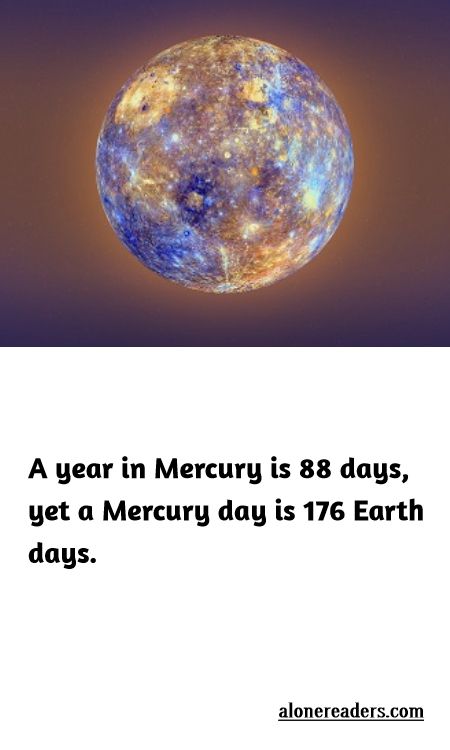
Mercury, the closest planet to the Sun, has some of the most extreme and intriguing characteristics in our solar system, particularly when it comes to its orbital dynamics and rotation. One of the most fascinating aspects is its year and day length. A year on Mercury — the time it takes for the planet to complete one orbit around the Sun — is just 88 Earth days. However, a single day on Mercury, defined as one full rotation on its axis relative to the Sun, lasts significantly longer, about 176 Earth days.
This unusual relationship means that Mercury rotates very slowly compared with its orbital period. This phenomenon, known as a 3:2 resonance, results in Mercury rotating three times on its axis for every two orbits it completes around the Sun. This orbital-rotational resonance keeps the day length precisely aligned with its year in a way that for every two Mercurial years, the planet experiences just one Mercurial day.
The reason behind this peculiar synchronization between Mercury's rotational period and its orbit is thought to be due to the influence of the Sun’s gravitational forces on the planet. Given Mercury’s proximity to the Sun and its elongated orbit, tidal forces exerted by the Sun have significantly altered its rotational behavior. Over millions of years, these forces have slowed Mercury’s rotation to its current state, locking it in the unique 3:2 spin-orbit resonance.
This means that if you were standing on Mercury's surface, you would experience extremely long days and nights. Sunrise to sunrise on Mercury takes about one Mercurial year (88 Earth days), and for about two-thirds of this time period, the Sun would be visible in the sky. However, despite the lengthy daylight, the slow rotation also means slower changes in temperature, with the planet's surface experiencing prolonged periods of both intense solar heating and darkness.
Understanding the dynamics of Mercury’s rotation and orbit provides not only insights into its geological and atmospheric properties but also into the complexities of planetary formation and tidal interactions in our solar system. It serves as a compelling example of how celestial mechanics can produce fascinating and extreme environmental conditions on other planets.
