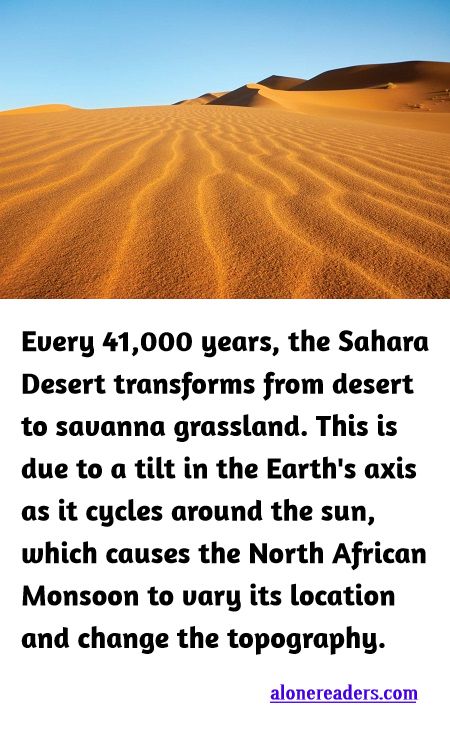
The Sahara Desert, one of the largest deserts in the world, renowned for its harsh, arid conditions, actually undergoes a dramatic transformation approximately every 41,000 years. This vast expanse, typically synonymous with sand dunes and scorching heat, surprisingly morphs into lush savanna grassland. The catalyst behind this remarkable transformation lies in the subtle tilt of Earth’s axis, a component of the complex astronomical motions that the Earth undergoes.
As the Earth orbits the sun, its axial tilt varies over time in a cycle that significantly impacts the climate and ecosystems. This axial tilt, or obliquity, changes the amount of solar energy different regions of the Earth receive, thus affecting weather patterns globally. In the case of the Sahara, the increased tilt enhances the intensity of the North African Monsoon. A greater axial tilt during this cycle increases the Southern Hemisphere's exposure to the sun, drawing the tropical rain belt, or Intertropical Convergence Zone, farther north than usual during the Northern Hemisphere's summer.
This shift in the rain belt brings increased rainfall to the Sahara, rejuvenating the arid landscape and enabling it to support a rich diversity of life. Rivers and lakes reappear, and vegetation thrives, transforming the desert into a vast savanna grassland. This greener phase supports a variety of flora and fauna, starkly contrasting with the usual barrenness of the desert. Historical evidence suggests that human populations in the region adapted their lifestyles around these cycles, transitioning from nomadic herding to settled farming communities during wetter periods.
As the cycle progresses and the Earth's tilt decreases, the monsoonal rains retreat southward, and the Sahara gradually reverts to its desolate, desert state. It's fascinating to consider that such a relentless and unyielding environment as the Sahara Desert is, in fact, subject to such profound changes, dictated by the slow dance of astronomical bodies. The cyclical nature of this transformation not only underscores the interconnectedness of celestial mechanics and terrestrial weather but also illuminates the adaptability of ecosystems and human societies to ever-changing climates. The Sahara serves as a poignant reminder of the dynamic and ever-evolving nature of Earth's landscapes.
