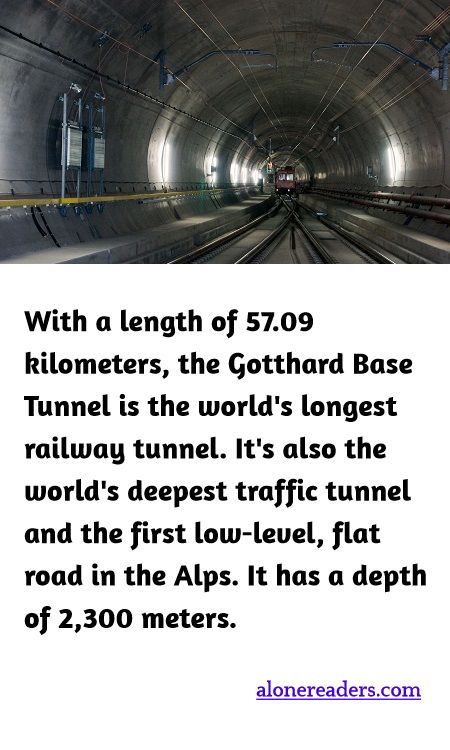
Spanning 57.09 kilometers, the Gotthard Base Tunnel holds the record as the longest railway tunnel in the world. Nestled deep in the heart of the Swiss Alps, it is not only celebrated for its length but also for its position as the deepest traffic tunnel globally, with sections running as deep as 2,300 meters below the mountain peaks. This engineering marvel marks a significant milestone in alpine transit, providing a low-level, flat roadway that significantly enhances the efficiency and safety of travel through this challenging mountain range.
The construction of the Gotthard Base Tunnel was an ambitious project, driven by the need to improve the transit time between northern and southern Europe and to boost the trade capabilities by providing a faster, more reliable route for goods and passengers. Launched after extensive planning, the tunnel took almost two decades to construct, involving thousands of workers and cutting-edge technology. The breakthrough was achieved in 2016, and since then, it has drastically reduced travel times, cutting the journey between Zurich, Switzerland, and Milan, Italy to just under three hours.
The tunnel's strategic importance extends beyond just improving travel times; it plays a crucial role in European transport logistics. By allowing flat and straight passages at low altitudes, it avoids the natural barriers posed by the Alps, effectively removing the geographical constraints that have historically hindered transportation and economic exchanges across Europe. This has not only facilitated smoother and more efficient transit but also contributed to environmental conservation efforts by diverting freight from roads to rails, thus reducing carbon emissions and traffic congestion.
In conclusion, the Gotthard Base Tunnel is much more than a feat of modern engineering. It is a pivotal infrastructural element that has redefined Alpine transit, enhancing economic interactions and connectivity across Europe. Its construction showcases the remarkable capabilities of contemporary engineering and sets a new benchmark in the field of transportation infrastructure.
