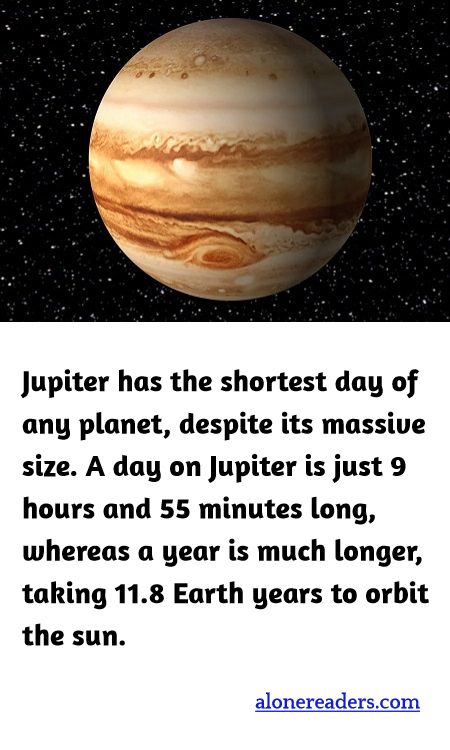
Jupiter, the largest planet in our solar system, presents a fascinating case when comparing the length of its day to its size. Despite its massive dimensions, Jupiter boasts the shortest day of any planet, completing one rotation on its axis every 9 hours and 55 minutes. This rapid rotation is even more intriguing given the planet’s enormous size, with a diameter of about 86,881 miles, which is 11 times wider than Earth.
The swift rotation of Jupiter significantly influences its atmospheric dynamics and magnetic field. The rapid spinning causes strong jet streams, separating its clouds into dark belts and bright zones that encircle the planet. These prominent bands, coupled with the famous Great Red Spot, a giant storm larger than Earth itself, highlight the complex and dynamic atmosphere of Jupiter.
Contrastingly, though its day is remarkably short, Jupiter has a lengthy orbital period around the sun. It takes about 11.8 Earth years for Jupiter to complete one orbit. This vast orbit, combined with its rapid rotation, leads to some unique astronomical phenomena. The intense centrifugal force caused by the rapid rotation makes Jupiter an oblate spheroid, meaning it has a noticeable bulge around the equator.
This interplay between rotation and orbital dynamics not only influences Jupiter’s physical shape and weather patterns but also contributes to its strong magnetic field, which is the strongest in the solar system, excluding the sun. This magnetic field traps particles of sulfur dioxide among others, emanating from volcanoes on Io, one of its 79 known moons. This creates a donut-shaped radiation belt that is one of the harshest radiation environments in the solar system.
Understanding Jupiter's quick rotation and long orbital period provides not only insights into its structure and atmospheric behaviors but also enhances our knowledge of planetary science as a whole. This giant planet serves as a natural laboratory for studying fluid dynamics, atmospheric chemistry, and planetary magnetospheres, which are crucial for understanding both the planets in our solar system and the countless others across the universe.
