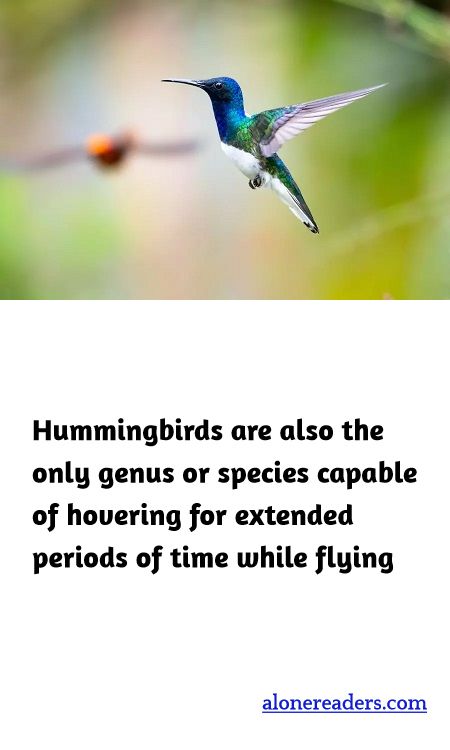
Hummingbirds, remarkable for their tiny size and dazzling colors, possess a unique ability among birds: they can hover in mid-air for extended periods. This extraordinary skill is primarily due to the structural and biomechanical properties of their wings. Unlike other birds, hummingbirds have a unique ball-and-socket joint at the shoulder that allows their wings to rotate almost 180 degrees in all directions. This enables them to flap their wings in a figure-eight pattern, which is efficient both for hovering and for agile maneuvering in flight.
The ability to hover allows hummingbirds to feed on nectar from flowers while airborne. This is crucial as their high metabolism requires them to eat many times their body weight in food each day to maintain their energy levels. To facilitate this, hummingbirds have evolved with extremely rapid wing beats, ranging from about 50 to over 80 beats per second depending on the species, which is much faster than any other bird species. The energy expenditure for such high wing-beat frequency and hovering ability is tremendous, making them one of the most energetically active groups of birds.
Their metabolism is similarly impressive. Hummingbirds consume a primarily liquid diet of nectar supplemented by insects and spiders for protein. They are able to rapidly assimilate and convert this food into energy. At night, to conserve energy, hummingbirds can enter a state of torpor, which is a form of deep sleep where their metabolic rate drastically slows down.
The remarkable hovering ability of hummingbirds is not just a flight of fancy but a necessary adaptation for survival. It allows them precise control over their position in space so they can extract nectar from flowers with great efficiency. The combination of energetic demands, unique structural adaptations, and their minuscule size makes hummingbirds not only a marvel of nature but also showcases the diverse evolutionary paths within avian species.
