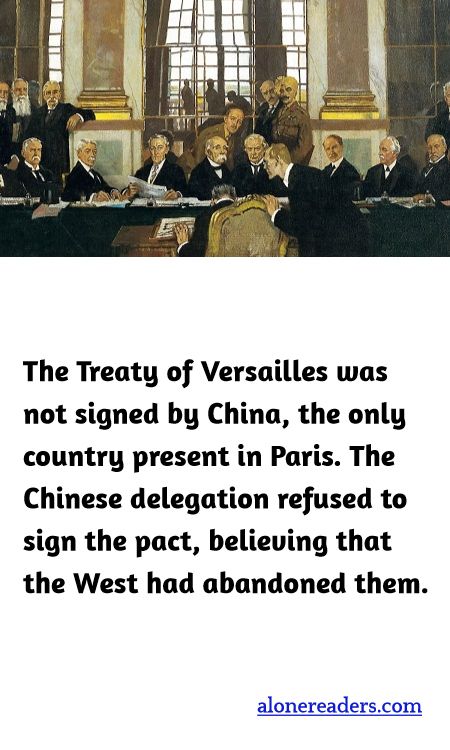
The Treaty of Versailles, concluded in 1919, marked the end of World War I and is primarily remembered for its harsh reparations imposed on Germany. Among the many national delegations present at the Paris Peace Conference, China stood out by refusing to sign the Treaty. This decision highlighted a significant moment of disillusionment and abandonment felt by China, despite its support for the Allies during the war.
China entered World War I on the side of the Allies in 1917, not with direct military involvement in Europe but primarily through labor support and logistical aid. The Chinese laborers, often overlooked in the annals of war history, worked under grueling conditions, contributing significantly to the Allied war effort. China’s participation was also motivated by the desire to shake off Japanese control over Chinese territory, particularly in Shandong province, which had been previously controlled by Germany and then seized by Japan early in the war.
During the peace conference, China expected the return of control over Shandong. However, the provisions of the Treaty of Versailles transferred German concessions in Shandong not back to China but to Japan. This decision was influenced by secret agreements and the geopolitics of the time, where Western powers, including the United States and Britain, favored Japan, a rising naval power in Asia. This apparent betrayal was met with outrage and a profound sense of betrayal across China.
The May Fourth Movement, which was a significant cultural and political movement among young Chinese intellectuals and students, emerged directly as a response to the treaty. On May 4, 1919, massive student protests broke out in Beijing and spread to other cities, marking a pivotal point in modern Chinese history. This movement galvanized a broader national awakening about China’s position in the world and sparked a reexamination of China's approach to foreign policy and its own cultural values.
China’s refusal to sign the Treaty of Versailles was a significant gesture, signaling its unwillingness to accept a Western-dominated international order that did not respect its sovereignty or its territorial claims. This event played a crucial role in the evolving narrative of modern Chinese nationalism and had lasting impacts on China’s subsequent interactions with both the West and Japan. China's position at Versailles demonstrated an early assertion of sovereign dignity and a refusal to be coerced by more powerful nations, shaping the course of Chinese foreign policy for years to come.
