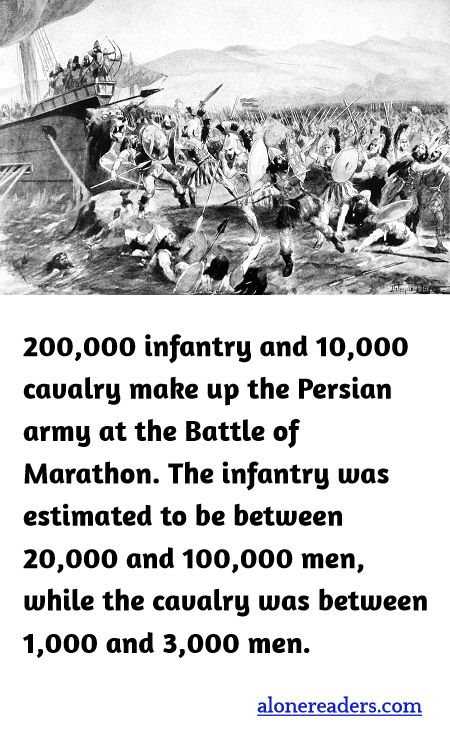
The Battle of Marathon, a pivotal encounter in 490 BC during the Greco-Persian Wars, is often cited for its legendary narrative and significant outcomes. Historical records on the size of the Persian forces at Marathon vary greatly, often embellished or understated by ancient sources. The most commonly referenced estimates suggest that the Persian army was composed of 200,000 infantry and 10,000 cavalry. However, modern historians debate these numbers, suggesting a range of 20,000 to 100,000 infantry and 1,000 to 3,000 cavalry.
The discrepancies in these numbers are partly due to the limitations of historical record-keeping, the biases of contemporary historians, and the logistical challenges of sustaining such a large force so far from home. The Persian army, drawn from across the vast empire, was nonetheless a formidable force that represented a significant threat to the much smaller Greek city-states.
The Greeks, particularly the Athenians, who led the charge at Marathon, were heavily outnumbered if the higher estimates are accurate. Despite this, the Greek forces managed not only to hold their own but to deliver a crushing defeat to the Persians. This victory was achieved thanks to a combination of rugged terrain, which was less favorable to the Persian cavalry, and the phalanx formation of the Greek hoplites, which proved effective in close combat.
The Battle of Marathon went down in history not just for the Greek victory but also for the dramatic aftermath, where the Athenian messenger Pheidippides allegedly ran approximately 26 miles to Athens to deliver news of the victory, leading to the modern marathon race. This battle underscored the resilience and strategic capabilities of the Greeks and marked the beginning of the rise of Athens as a significant power in the ancient world. The true scale of the Persian forces may never be fully known, but the impact of their defeat has echoed through history, symbolizing the triumph of the underdog in the face of overwhelming odds.
