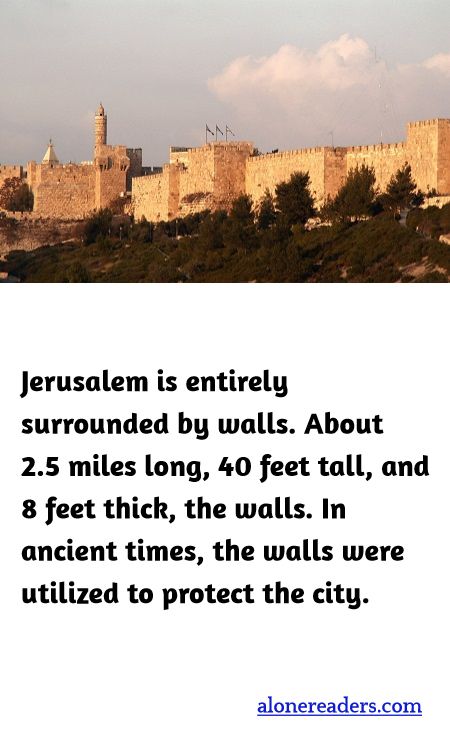
Jerusalem, a city steeped in history and considered sacred by three major world religions—Judaism, Christianity, and Islam—is famously enveloped by impressive ancient walls. These walls, about 2.5 miles in length, 40 feet in height, and 8 feet thick, are not just remnants of the past but a testament to the city's historical and strategic importance. Constructed primarily for protection against invasions, the walls of Jerusalem have withstood the test of time, surviving numerous battles, reconstructions, and restorations throughout various periods.
The current walls date back to the 16th century, when they were rebuilt by the Ottoman Sultan Suleiman the Magnificent. They encircle the Old City of Jerusalem, defining its boundaries and adding a tangible sense of the past in stark contrast to the bustling modern city that sprawls beyond them. Originally, these massive fortifications were built to shield the inhabitants from attacks and to control the entry and exit of goods and people, which was crucial for maintaining the city’s autonomy and economic stability.
As one walks through the gates that pierce the walls of Jerusalem, it's like stepping back in time. Each gate has its own story and character—from the heavily frequented Jaffa Gate, leading to the historic Armenian and Jewish quarters and the vibrant markets, to the Damascus Gate, which opens to the Arab bazaar and the Muslim Quarter. The walls and their gates not only offer a glimpse into the city's past conflicts and conquests but also reflect the cultural and religious melting pot that Jerusalem represents.
Moreover, these ancient walls are not solely of historical interest; they are also central to the identity and spiritual life of the city. They have witnessed prayers, processions, and pilgrimages over the centuries. Each stone in the wall could tell tales of ancient prophets, kings, pilgrims, and ordinary inhabitants whose lives were intertwined with the ebb and flow of the city’s fortunes. Today, they attract scholars, historians, archaeologists, and tourists from around the world who come to marvel at their grandeur and delve into their secrets.
Thus, the walls of Jerusalem serve as a symbol of endurance and continuity. Despite the many phases of construction and destruction, they stand resilient, preserving the essence of the city's glorious past and its hopes for a peaceful future. They remind us that while cities may grow and change, their histories are etched in stone and mortar, beckoning future generations to remember and respect the long journey through time.
