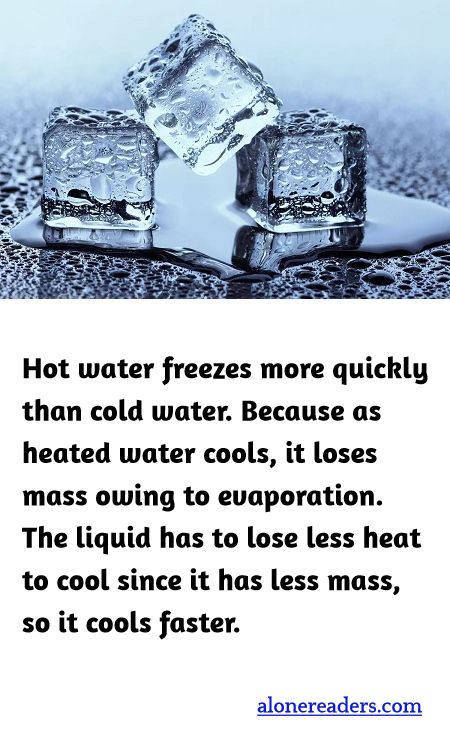
The phenomenon where hot water freezes faster than cold water is known as the Mpemba effect, named after Erasto Mpemba, a Tanzanian student who observed this curious behavior in the 1960s. The counterintuitive nature of this effect has puzzled scientists for decades, with various experiments confirming its reality, though not always consistently, and with a range of competing explanations proposed.
One commonly cited explanation is that hot water may cool faster initially due to the processes of evaporation and convection. When hot water is placed in a cooler environment, it tends to lose heat more quickly than cold water due to the greater thermal energy. Evaporation plays a significant role here, as the faster-moving molecules at the surface of the hot water escape into the air, taking heat with them. This reduces the quantity of the water and therefore the amount of heat energy required to freeze it. Additionally, evaporation cools the hot water more efficiently than the colder water, where the surface temperature decreases more slowly and less evaporation occurs.
Convection currents within the hot water can also contribute to faster cooling. In hot water, these currents are more vigorous, helping to distribute the heat throughout the container more quickly and efficiently, potentially leading to a faster equalization of temperature throughout the water. Once the hot water reaches the temperature of the cooler water, it may continue cooling at a more rapid rate, reaching freezing point before the initially cooler water.
Despite the plausible explanations, the Mpemba effect does not always occur and relies on a number of factors, including the initial temperature of the water, its purity, and the environment's temperature. Experiments have shown varying results based on different setups, suggesting that there's no single explanation that fully accounts for the phenomenon in every scenario. Moreover, some scientists point to additional factors such as the presence of dissolved gases and minerals which may affect the freezing process differently in hot versus cold water.
Understanding the Mpemba effect not only satisfies a scientific curiosity but could also have practical applications in areas ranging from industrial processes to climate science. Nevertheless, while the effect remains partially understood, the curiosity and investigation it sparks continue to contribute to our broader understanding of physics and thermodynamics. However, despite the ongoing investigation and hypotheses, the Mpemba effect continues to challenge our conventional understanding of how heating and cooling work, reminding us of the complexities of even seemingly simple physical phenomena.
