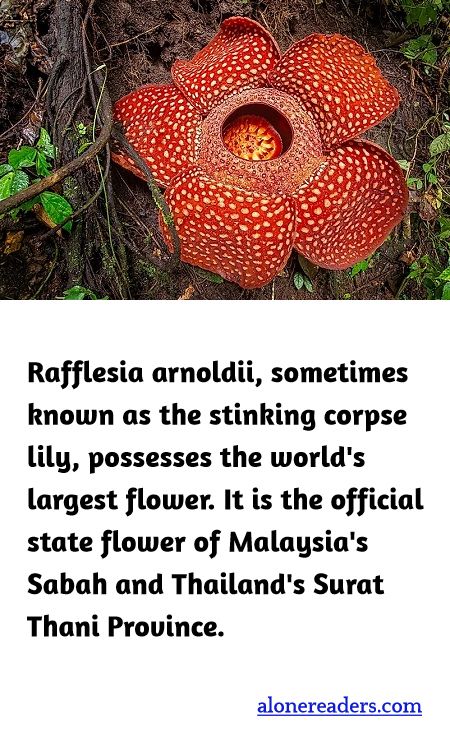
Rafflesia arnoldii, commonly referred to as the stinking corpse lily, is a plant that stands out in the botanical world not only for its immense flower size but also for its unusual characteristics. The flower holds the record for being the largest in the world, reaching up to three feet in diameter. Despite its striking size, Rafflesia arnoldii emits a repulsive odor similar to that of rotting flesh, which is a clever adaptation for attracting its main pollinators—carrion flies.
Native to the rainforests of Southeast Asia, particularly in Indonesia, Malaysia, and Thailand, Rafflesia's habitat is as unique as its appearance. This rare flower thrives only under specific conditions in the dense, moist forestry, making it an endangered species due to habitat loss and environmental changes. Its conservation status is a concern as the regions where it grows face deforestation and human encroachment, destroying its natural habitat.
The lifecycle of Rafflesia arnoldii is as intriguing as its physical attributes. This parasitic plant embeds itself in the vine of the Tetrastigma plant, which is related to the grapevine, drawing nutrients and water directly from its host. It does not have visible leaves, stems, or roots and leads a largely hidden existence until it blossoms spectacularly. The flower takes many months to develop, but once open, it lasts for just a few days.
Rafflesia arnoldii has been recognized for its unique qualities and significant botanical impact. It is the official state flower of Sabah in Malaysia and Surat Thani Province in Thailand, symbols of pride and natural heritage in these regions. Efforts to conserve this spectacular species continue, aiming to preserve its place within the ecological landscape and maintain the biodiversity of its rainforest home. Through such initiatives, future generations may continue to witness the grandeur of the world's largest flower and further understand the complex interdependence within tropical ecosystems.
