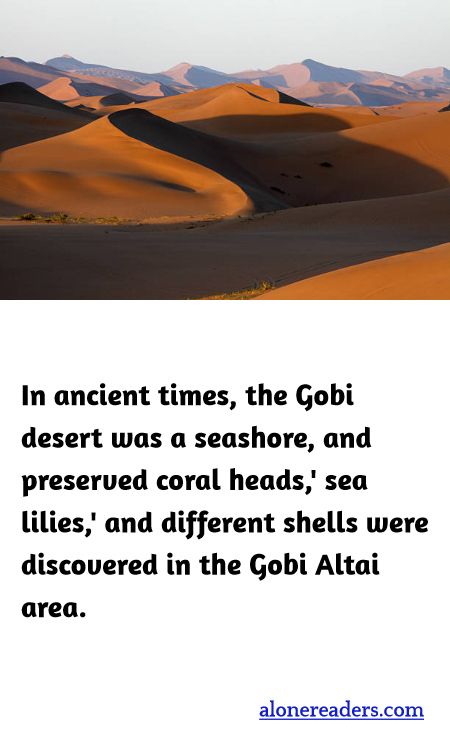
The Gobi Desert, a vast arid region spanning northern China and southern Mongolia, is often associated with its stark landscapes and extreme conditions. However, surprising evidence suggests that this now-dry expanse was once an ancient seashore. Research and geological surveys in the Gobi Altai area have unearthed fossils that paint a vivid picture of its prehistoric marine environment.
Among the most striking discoveries in this region are the fossilized remains of coral heads and sea lilies, along with various types of shells. These marine fossils indicate that during the Paleozoic era, much of what is now the Gobi Desert was submerged beneath a vast sea. Over millions of years, tectonic activities and climate changes dramatically transformed the landscape, leading to the retreat of these waters and the emergence of the desert environment we see today.
The presence of coral fossils is particularly noteworthy. Corals, which are marine invertebrates, form some of the most diverse ecosystems on Earth, known as coral reefs. These structures are typically found in shallow, warm waters and are highly sensitive to the environmental conditions. The discovery of coral fossils in the Gobi Desert suggests that the region once enjoyed a significantly warmer and more humid climate, supporting a rich marine life.
Similarly, fossils of sea lilies, or crinoids, contribute to this marine narrative of the Gobi. Crinoids are echinoderms related to starfish and sea urchins. In their living state, they are attached to the sea floor by a stalk and have a crown that consists of feathery arms used for feeding. Their presence in the fossil record of the Gobi Desert further confirms the existence of an ancient sea where these creatures thrived in considerable numbers.
These findings not only provide insights into the climatic and ecological history of the Gobi Desert but also underscore the dynamic nature of Earth’s surface. The fact that a desert as arid as the Gobi was once a thriving marine habitat reminds us of the planet’s capacity for extreme environmental changes. It also poses intriguing questions for paleontologists and geologists about the timing and processes of these transformations.
Understanding the history of the Gobi Desert also has implications for studies on climate change and desertification. By examining the fossil records and the sedimentary structures, scientists can gather clues about how and why climatic shifts occur and what effects they might have on habitats. This underlines the importance of geological studies in predicting future environmental changes and preparing for their potential impacts. Such knowledge is crucial, not just from an academic perspective, but also for the sustainable management of our planet's natural resources and ecosystems.
