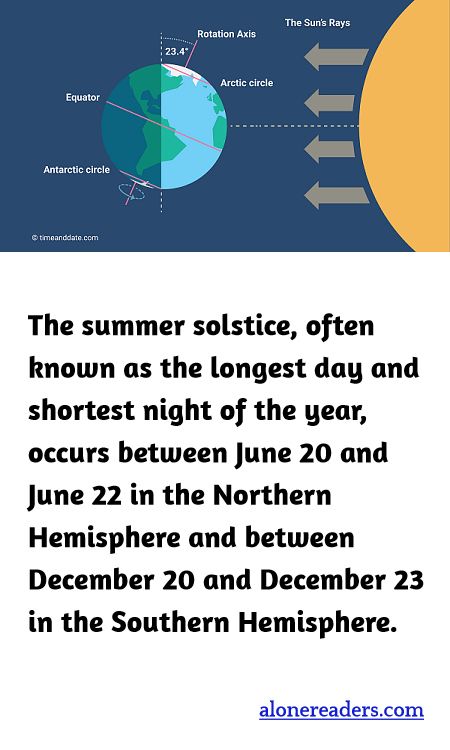
The summer solstice, marking the longest day and shortest night of the year in its respective hemisphere, is a celestial event of great significance and celebration around the world. In the Northern Hemisphere, this solstice takes place between June 20 and June 22, heralding the official commencement of summer. Conversely, in the Southern Hemisphere, the solstice occurs between December 20 and December 23, indicating the onset of summer there.
The phenomenon of the summer solstice occurs due to the Earth's tilt on its axis. As the Earth orbits the sun, its tilted axis always points in the same direction. Thus, during the solstice, one hemisphere is tilted more towards the sun than at any other time of the year. This results in the maximum number of daylight hours and the warmest temperatures of the season due to the increased direct sunlight.
Culturally, the solstice is steeped in history and tradition. In many ancient civilizations, it was celebrated with festivals and rituals. For example, the ancient Greeks marked the start of their new year and a festival for the god of agriculture, Cronus, during the summer solstice. Similarly, in Scandinavia, where the sun sets for only a few hours, the solstice is celebrated with huge bonfires, feasting, and merriment. Perhaps one of the most iconic celebrations related to the solstice is at Stonehenge in England, where thousands gather to witness the sunrise aligning perfectly with this ancient monument.
In recent times, this astronomical event also highlights important environmental imbalances and seasonal effects on ecosystems, reminding us of our shared responsibility towards planet Earth. Many environmental groups use this day to encourage action on climate change and awareness about renewable resources.
Despite our modern understanding and the technological advances of civilization, the summer solstice continues to captivate the imagination and serves as a reminder of our connection to the natural world and the cosmos. It is a time for renewal, celebration, and appreciation of the sun's life-giving energy, deeply ingrained in human tradition and the rhythm of our planet.
